How to Style Open Shelves Without the Clutter
Learn how to style open shelves so they feel calm and intentional, not chaotic. Practical shelf styling ideas to declutter and pull the look together.

· 6 min read
Open shelving looks effortless in photos, but in real life it can quickly turn into a landing strip for mail, mugs, and half-read books. The problem usually is not that you own too much. It is that everything is competing for attention at once. This guide walks you through how to style open shelves so they read as calm and considered, using a few repeatable habits rather than a full redecoration.
Start by clearing everything off
Before you arrange anything, take it all down. Wipe the surfaces and look at the empty shelves for a minute. This matters because you cannot see the shape of a good arrangement when it is buried under a year of accumulation, and editing in place almost always leaves too much behind.
Sort what you removed into three piles: keep and display, store elsewhere, and let go. Be honest about the middle pile. That stack of takeout menus does not need to live at eye level.
A common mistake is to put back roughly what was there. Resist it. The whole point is to decide fresh what earns a spot, not to recreate the clutter with slightly straighter edges.
Give every shelf a job
Decide what each shelf is actually for before you fill it. One shelf might hold books, another a few pieces of pottery, another everyday glassware you reach for daily. When a shelf has a clear purpose, you naturally stop cramming unrelated items onto it.
For example, in a kitchen you might reserve the lowest open shelf for the plates and bowls you use every day, and keep the higher shelf for a couple of decorative bowls and a small plant. Function on the bottom, personality on top.
The mistake to avoid here is treating open shelving as general storage. If it holds a bit of everything, it will always look like a bit of everything. Assign roles and the eye relaxes.
Work in small groupings
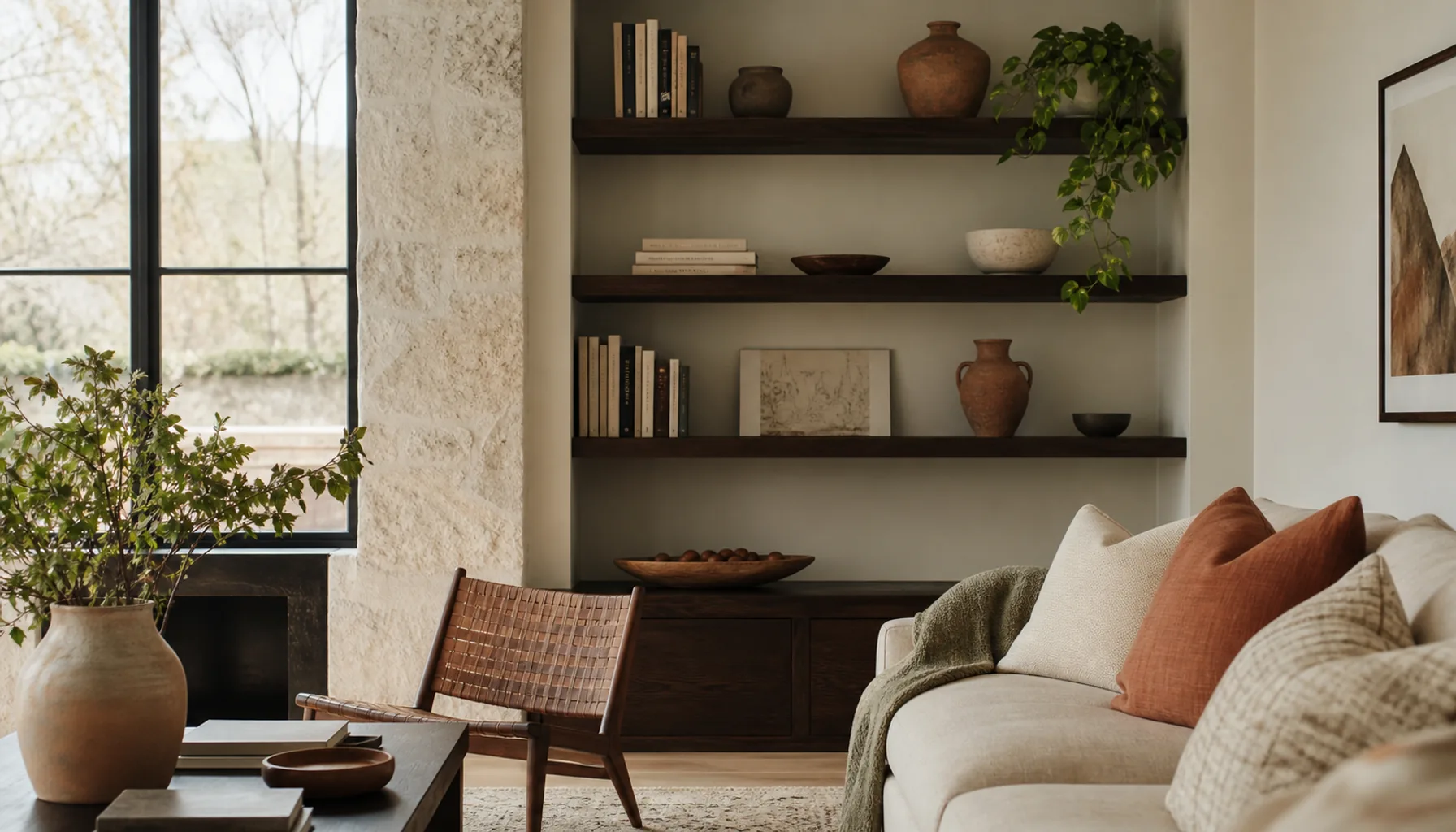
Objects look intentional when they are grouped rather than spread evenly like items on a store shelf. Cluster three to five pieces together, then leave clear space beside them. These small vignettes give your eye a place to land and a place to rest.
A simple recipe for a grouping:
- One tall anchor (a vase, a stack of books stood upright, a framed print)
- One mid-height piece with a different shape (a bowl, a candle, a small sculpture)
- One low or organic element (a trailing plant, a stone, a folded textile)
- A little empty space around the cluster so it can breathe
Group these in odd numbers and vary the heights. The mistake is lining everything up in a neat, evenly spaced row. Straight rows feel like inventory, not styling.
Let negative space do the work
Empty space is not wasted space. The gaps between objects are what make the objects themselves feel chosen. If you fill every inch, nothing stands out and the whole shelf reads as noise.
Aim to leave roughly a third of each shelf empty. That breathing room is the single fastest way to make a busy shelf look calm.
Picture two identical shelves. One is packed corner to corner; the other holds the same style of pieces with clear gaps between groupings. The second looks deliberate every time. If you struggle to leave gaps, remove one item from each shelf and see how it feels. Usually it feels better.
Build a quiet color story
Clutter is often really a color problem. Ten different finishes and bright packaging read as chaos even when the shelf is tidy. Pulling your palette toward a few repeating tones makes a mixed collection feel intentional.
Choose two or three main colors plus a neutral, and let those repeat across the shelves. Wood tones, cream, and a single accent like deep green will carry a lot of variety without feeling loud. If you want help settling on those tones for the wider room, our guide to choosing a color palette for a small living room walks through it step by step.
The mistake to avoid is displaying things purely because they are colorful. A bright box of cereal or a logo-covered tin breaks the story instantly. Decant loose items into plain containers, or move them behind a cabinet door.
Mix textures and materials on purpose
A palette keeps things calm, but too much sameness gets flat. The fix is texture. Combine smooth ceramic, rough stone, woven baskets, and matte metal so the shelf has depth even within a restrained color range.
For instance, a stack of linen napkins next to a glazed jug and a raw wooden board gives you three surfaces catching light differently, all in the same warm neutral family. If you want to go deeper on pairing surfaces, our beginner's guide to mixing textures covers how to combine them without clashing.
The mistake is relying on one material for everything. A shelf of all-glossy ceramics or all-woven baskets reads as monotonous, and monotony is its own kind of visual clutter.
Contain the small stuff
The items that make shelves look messy are almost always the small, loose ones: chargers, receipts, keys, spare batteries. These do not need to disappear from your life, but they should disappear from view. Corral them into a lidded box, a tray, or a basket that matches your palette.
A single closed box on an open shelf reads as one clean object, while the same contents loose would read as fifteen bits of noise. Give each type of small item a home and keep the container in the same spot so tidying becomes a two-second habit. For more ideas on hiding the practical stuff, see these small apartment storage ideas that actually work.
The mistake here is buying decorative baskets and then leaving clutter around them. The container only helps if the small things actually go inside it.
Style at eye level first
Your eye lands on the middle shelves before anything else, so style those most carefully. Put your best pieces and clearest groupings where you naturally look, and let the top and bottom shelves stay simpler. This focuses your effort where it shows and keeps you from spreading yourself thin.
As an example, place a favorite piece of pottery and a small framed photo at eye level, and reserve the highest shelf for a couple of larger, plainer items that fill space without demanding attention.
The mistake is treating every shelf as equally important. When you do, nothing leads the eye, and the arrangement feels flat no matter how nice each object is.
Bringing it together
Styling open shelves is less about buying new things and more about editing, grouping, and giving your eye room to rest. Clear everything off, give each shelf a job, work in small groupings with plenty of negative space, and keep your colors and containers quiet. Do that and even a well-used shelf will feel calm and intentional.
If you are not sure which look suits your space, try the Room Style Finder to get a starting point tailored to your room, then style your shelves to match.
One useful home email a month
Real ideas to make your home work better. No spam, easy unsubscribe.