12 Cabin-Style Decor Ideas for a Small City Apartment
Cabin-style decor ideas for a city apartment: wool, pine, worn utility objects, and warm low light that work with no fireplace and no timber beams.

· 14 min read
A cabin gets its atmosphere from things an apartment does not have: solid timber walls, a fire, small deep-set windows, and weather outside them. Copy the surface details without those and you get a costume. Plank wallpaper, a moose pillow, a plaid throw, and the room still feels like a rental with props in it.
Translation works better than imitation. What a cabin actually delivers is weight underfoot, wool you can feel, low pooled light instead of overhead light, and a sense of being enclosed. All four are available in a fourth-floor walk-up with white walls and a radiator.
Key Takeaways
- Wool is the primary material, not wood. It carries the weight, warmth, and sound absorption a timber shell would otherwise provide.
- Nothing genuinely replaces a fire. A low cluster of warm lamps gets you the pooled light and the focal point, and the honesty should stop there.
- Put the wood in freestanding pieces, not on the walls. Softwood with knots and real thickness reads as cabin; a printed plank finish does not.
- Plaid needs rationing. One large-scale checked piece per room. Two looks themed.
- Dark paint belongs in one small room only, ideally one without much daylight.
- Worn utility objects beat cabin-themed decor. A dented enamel jug says more than anything with an antler on it.
12 Cabin-Style Decor Ideas Worth Trying
Idea 1: Start With Wool, Not Wood
Most people begin with wood and wonder why the room still feels thin. Wool is what makes a cabin feel like a cabin from the inside: it holds heat, it deadens the echo off hard surfaces, and it looks heavy before you touch it.
Buy fewer and thicker. One dense wool throw with real weight beats four thin acrylic ones, and it will not pill into fuzz by February. Look for chunky knits, brushed lambswool, felted wool, and blanket-weight plain weaves in oatmeal, charcoal, camel, and undyed gray.
Where it goes matters. Folded over a sofa arm, across the foot of the bed, hung on a peg by the door. Wool works when it looks recently used rather than arranged, which is the opposite of how most throws get styled.
Idea 2: Build a Hearth Where There Is No Fireplace
No substitute actually replaces fire. Nothing you can put in an apartment flickers unpredictably or throws heat you feel from six feet away. What you can rebuild is the effect a hearth has on a room: one low, warm, bright spot that pulls everyone toward it.
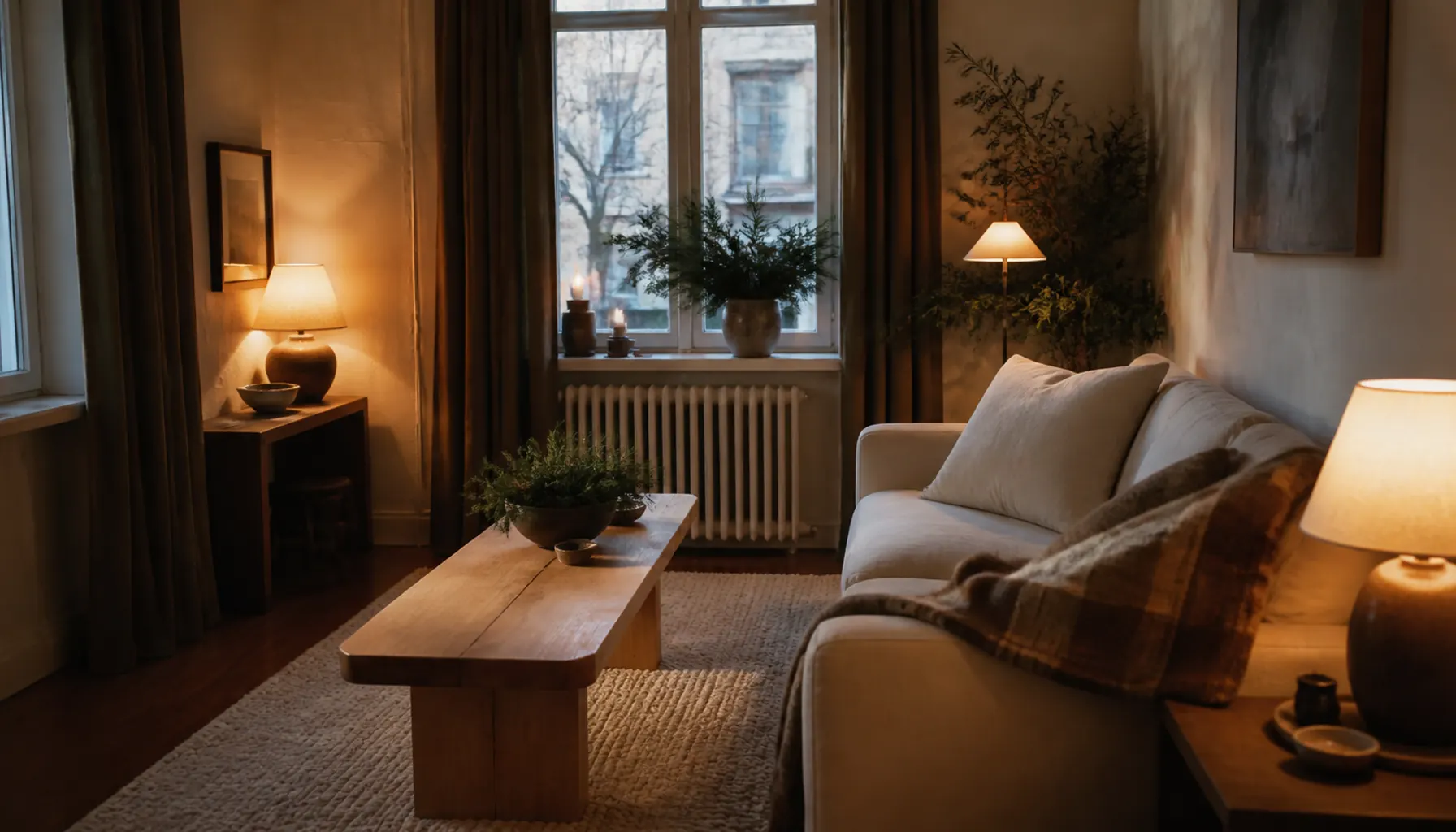
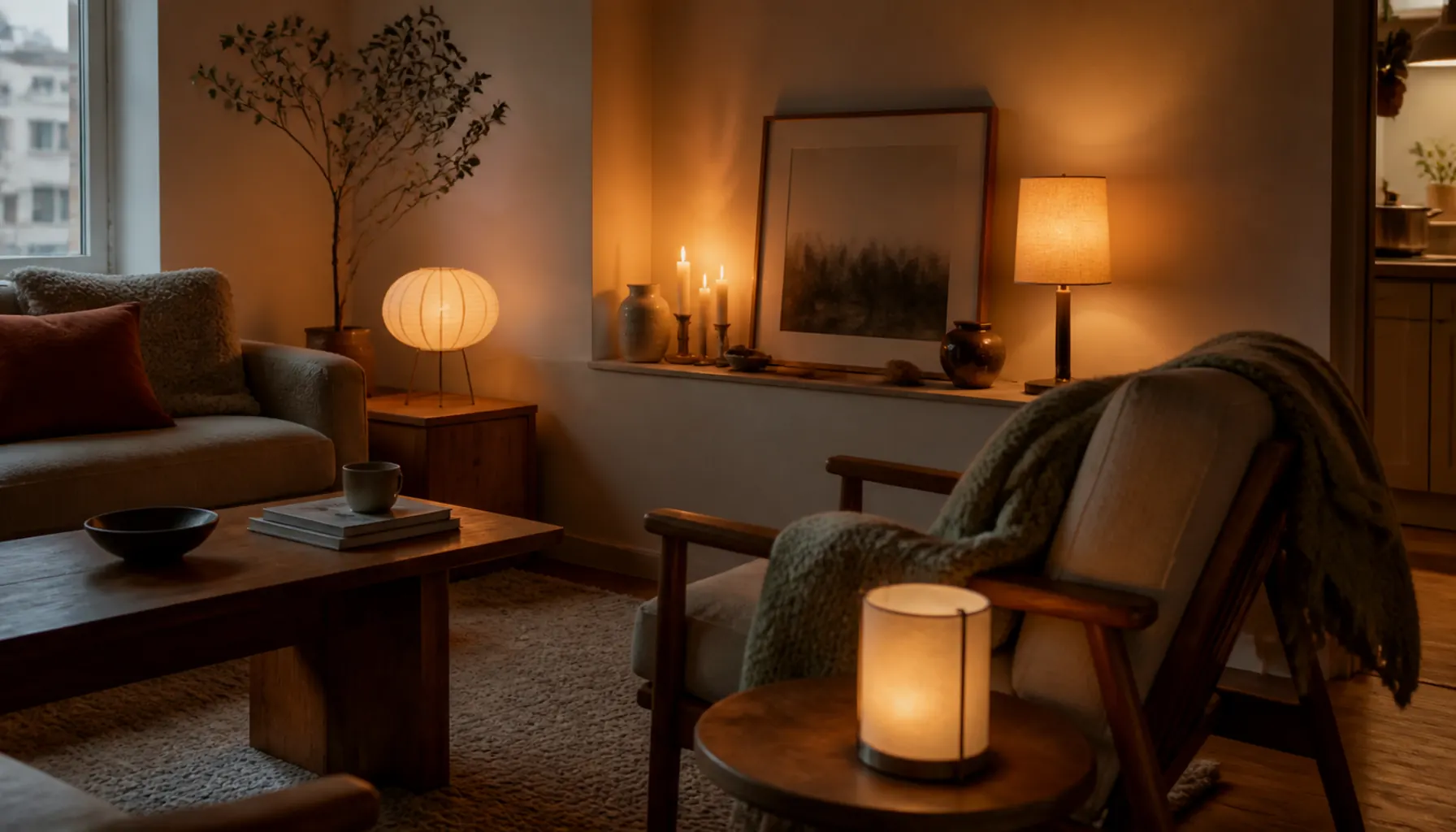
Pick a corner or a short wall and cluster three light sources low. A table lamp with an opaque shade on a stool, a small floor lamp with its shade below eye level, and a row of candles on a ledge. All warm, all dim, all under waist height.
Keep candles well away from fabric and never leave them burning in an empty room.
Idea 3: Buy Softwood Furniture With Visible Mass
You cannot line a rental in timber, so the wood has to arrive as furniture. Softwood is the right family: pine, spruce, fir, and larch have wide grain, visible knots, and they yellow with age instead of staying uniform.
Thickness sells it. A two-inch pine plank tabletop, a bench with a solid seat, a blanket chest, a stool cut from one piece. Thin veneered panels read as flat-pack whatever the finish claims.
Skip the matched bedroom set. Cabins accumulate; they are not furnished in one afternoon. A dark old pine chest beside a pale new pine bench looks like two decades of use, and our notes on mixing light and dark wood furniture keep that deliberate rather than accidental.
Finish with oil or wax, not gloss. Bare pine takes a scuff and looks better for it.
Idea 4: Run One Thick Plank High Across a Wall
A single board does more than a whole wall of paneling. Mount a rough-sawn plank, roughly six to eight inches deep, high on one wall on two heavy brackets. That gives you the horizontal timber line a mantel or ceiling beam would, plus a ledge for candles and books.
Height is the decision. Too low and it reads as a shelf; set roughly where a mantel would sit, above the main seating, and it reads as architecture. Find the studs, because a plank with anything on it is heavier than it looks.
Cannot drill? Peel-and-stick wood panels and beadboard are the usual suggestion and the weakest version of this, since printed grain has no thickness and no edge. If you try it, test the adhesive somewhere hidden first, as our peel-and-stick rental projects guide explains, and keep it small, such as the back of an alcove.
Idea 5: Drop the Light Low and Warm
Cabin light comes from lamps, fire, and small windows, all of it low and uneven. Apartment light comes from a fixture in the middle of the ceiling. That single difference explains most failed attempts at this look.
Turn the ceiling light off and leave it off. Replace it with three or four separate sources at different heights, none above head level except a shaded pendant. Uneven pools with dark gaps between them are the goal, not even coverage.
Bulb temperature does the rest. Stay at the warm end, around 2200K to 2700K, and use dimmers where you can. A cool white bulb in a beautiful lamp still reads as an office, which is one of the lighting mistakes that make rooms feel cold.
Idea 6: Layer Rugs Over Hard Apartment Floors
Laminate and thin engineered floors are loud, cool, and flat. One rug helps. Two overlapping rugs get you closer to a floor walked on for years.
Use a large flat weave as the base, sized so it reaches under at least the front legs of the seating, then drop something softer and smaller on top where feet actually land. Sheepskin, a felted wool mat, or a small hand-knotted piece. The rug sizing guide covers the base layer, which is the one people undersize.
Put a grip pad under the bottom rug or the whole arrangement slides on a hard floor. And keep the top piece small enough to look dropped rather than centered, since a second rug placed exactly in the middle looks like a mistake.
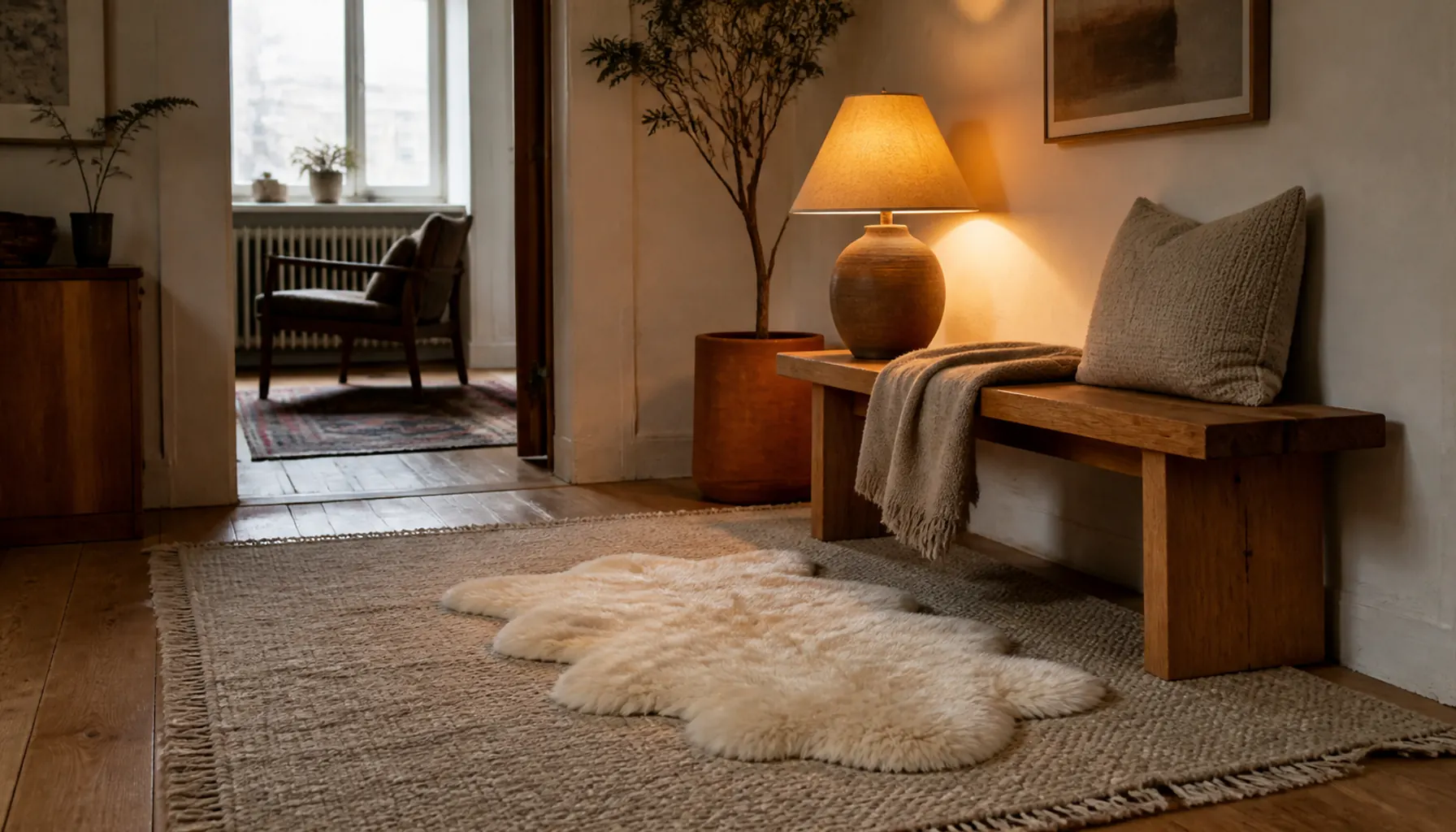
Idea 7: Scale Cabin Furniture Down to One Heavy Piece
Cabin furniture is built chunky, and chunky pieces multiply badly in a small room. Four heavy things in a fifteen-foot space stop reading as rustic and start reading as blocked.
Allow yourself one genuinely heavy anchor: the plank table, the blanket chest, or a deep armchair with a solid frame. Everything else should be visually lighter. Pieces on legs you can see under, an open ladder shelf, a stool instead of a second side table.
Depth is the number to watch. A deep-seated armchair in a narrow room eats the walkway, and you feel that every day. Measure the path from door to window and keep it clear before falling in love with the chair.
Small rooms take darker, heavier finishes better than people expect. What they cannot take is four of them.
Idea 8: Paint One Small Room Dark and Stop There
Enclosure is the hardest cabin quality to fake, and dark paint is the cheapest way to get it. The catch is that it works in one room, not throughout.
Choose the smallest, dimmest room you have: a windowless bathroom, a hallway, a small bedroom, an alcove. Rooms with little daylight lose almost nothing by going dark and gain a wrapped, den-like quality at once. Warm darks hold up best: deep brown-black, bitter chocolate, a green so dark it reads near-black, or a charcoal with red rather than blue in it.
Paint the trim and the inside of the door the same color. A dark room with white trim looks like a mistake framed in white. Matte or eggshell, never satin, since shine on a dark wall shows every roller mark.
Our whole-house paint palette guide covers how one dark room should hand off to the lighter ones around it.
Idea 9: Use Worn Utility Objects Instead of Cabin Decor
Real cabins are full of things kept because they work. A chipped enamel jug, a cast iron pan on a hook, a galvanized bucket, wooden crates, leather straps, rope.
Wear is the point, and it has to be real. Genuine wear is uneven: paint gone where hands held it, intact everywhere else. Factory distressing is even, which is why it never lands. Thrift stores and estate sales are the sources, and our guide to thrift furniture worth flipping applies to small objects too.
Give them a job rather than a display shelf. Hooks by the door holding actual coats, crates holding magazines, the jug with dried grasses.
Worth Avoiding: Anything with a bear, a moose, or the word "lodge" printed on it. Cabin style comes from materials and wear, not iconography.
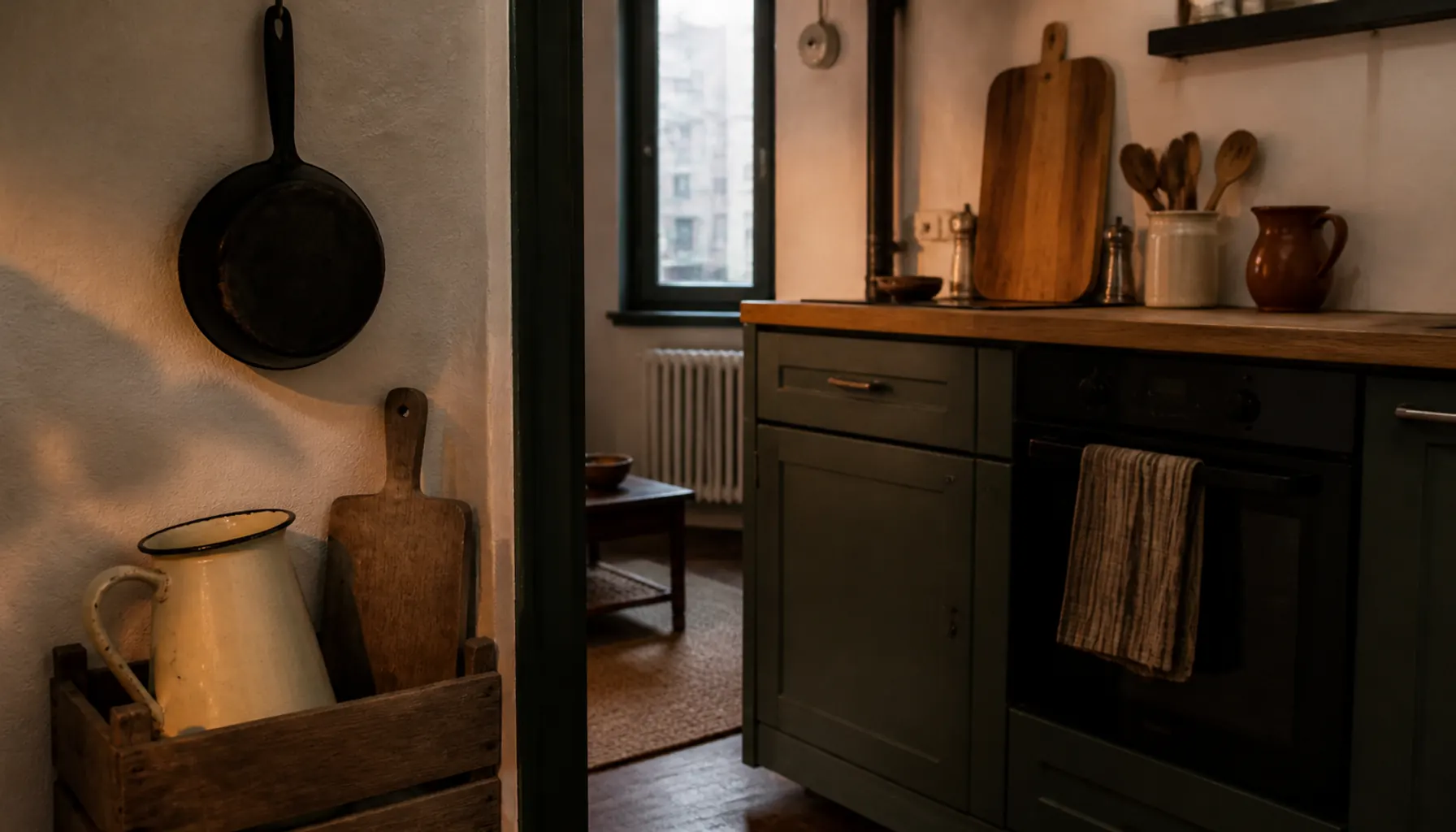
Idea 10: Ration the Plaid to One Large Piece
Plaid is the fastest route to theme-park cabin, and genuinely useful in small doses. The fix is quantity and scale rather than avoidance.
One checked piece per room, and make it large: a blanket, a single armchair, one pair of curtains. Large-scale checks in muted colors read as textile; small tight checks in bright red and black read as a costume shop.
Color does most of the work. Low-contrast combinations hold up far longer: gray on charcoal, oatmeal on camel, faded olive on cream, or a buffalo check where the red has gone brick rather than fire engine.
Buffalo check, tartan, and windowpane in the same room cancel each other out. Pick one pattern family and let plain wool textures carry the rest, along the lines of the texture mixing basics that keep a neutral room from going flat.
Idea 11: Wrap the Room Instead of Opening It Up
Most apartment advice pushes toward light and openness. Cabin style wants the opposite, and this is where the two genuinely conflict.
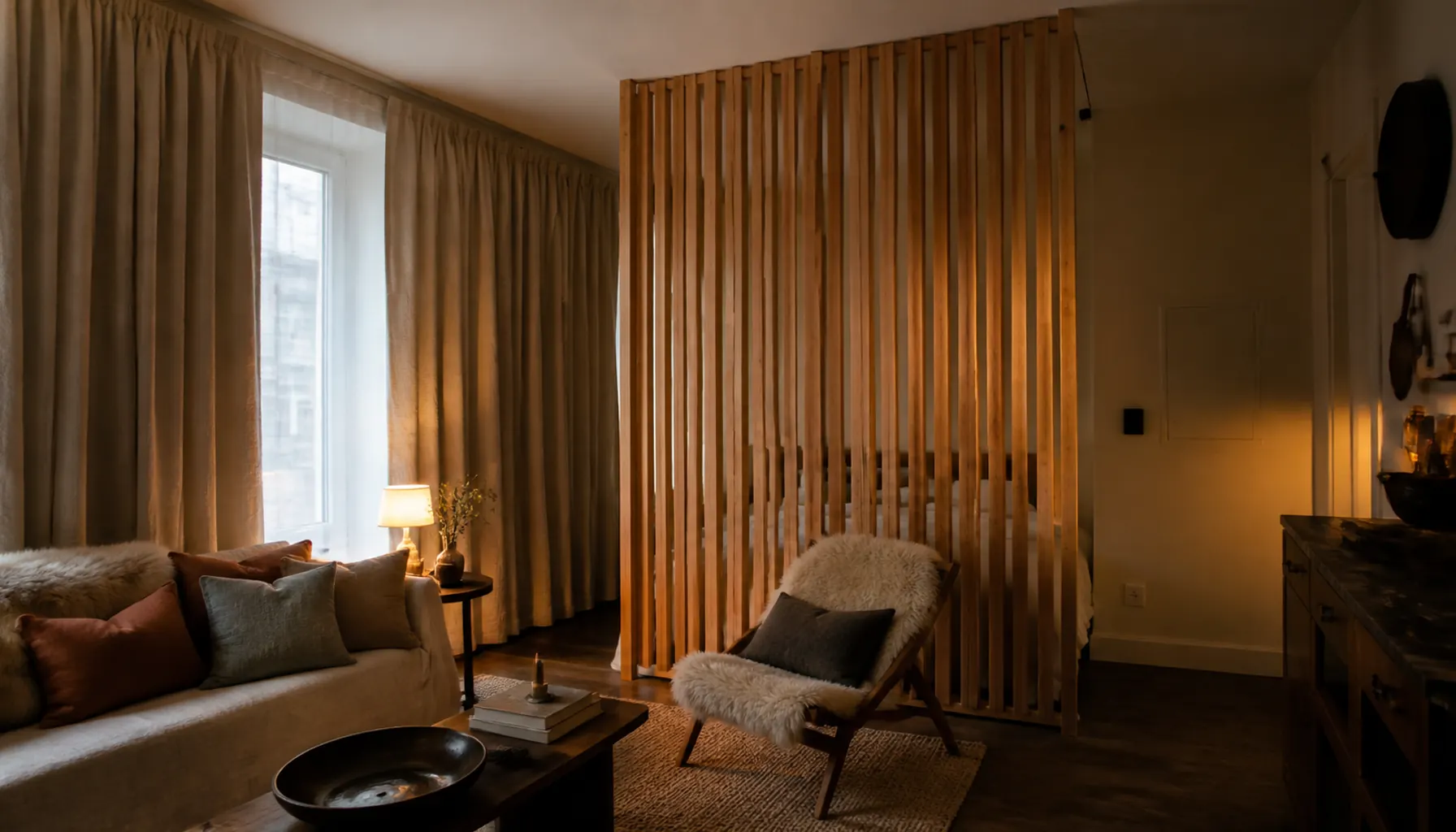
Curtains do the heaviest lifting. Hang the rod wider and higher than the window and use fabric with real body: wool, heavy cotton canvas, or thick linen. Let the panels cover wall as well as glass, so that end of the room reads as soft rather than a hole punched in plaster. The window treatment guide covers hanging heights; here you want fullness over flat panels.
In an open-plan apartment, break the space rather than celebrating it. A tall bookcase turned side-on, a slatted screen, or a heavy curtain makes two smaller rooms that both feel held.
Low is the other lever. A lower table, seating you sink into, and art hung slightly below the usual height pull the room's center of gravity down.
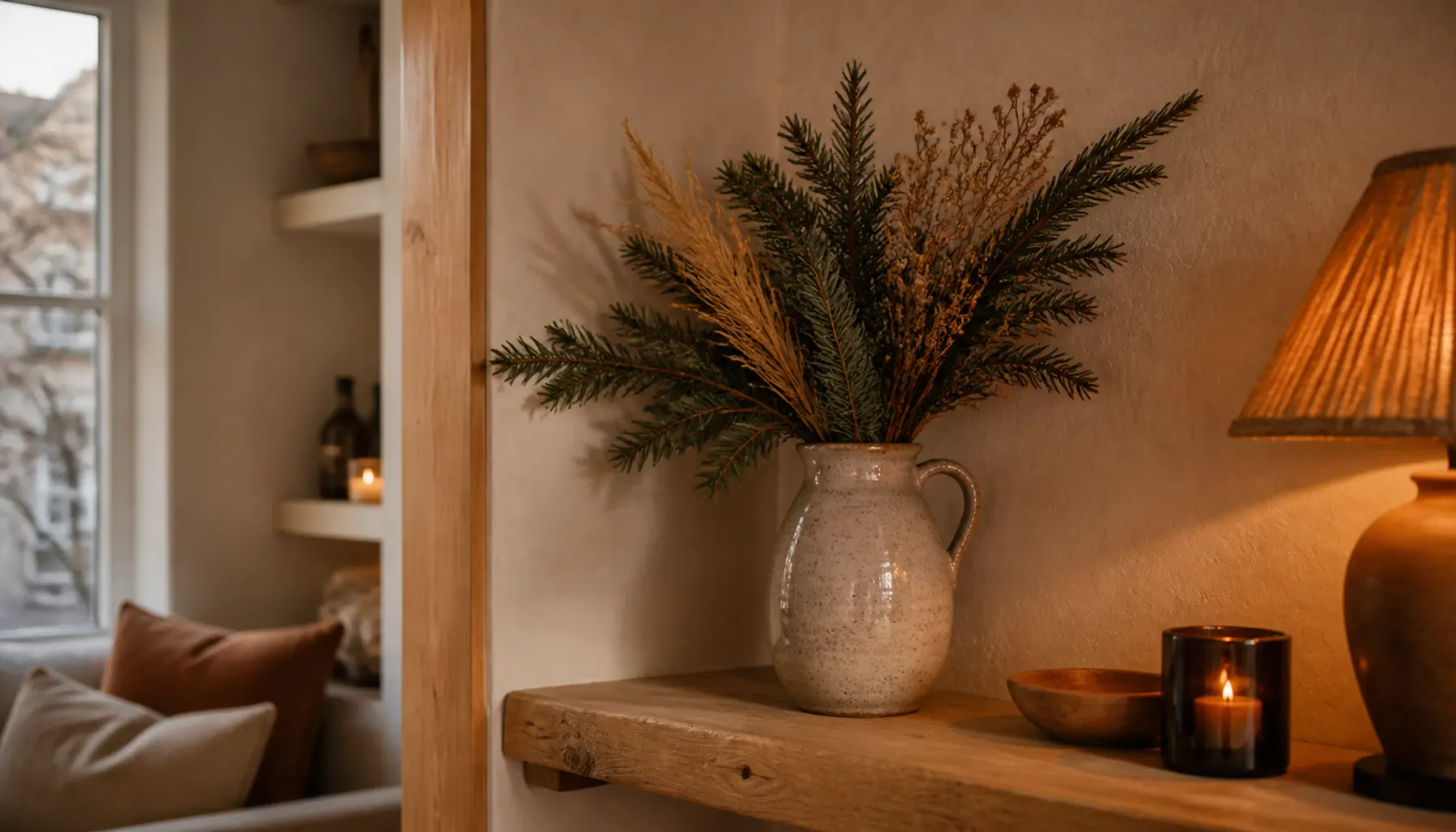
Idea 12: Bring Greenery In Cut, Not Potted
Cabin greenery arrives from outside and eventually dies. That is a different look from a styled collection of houseplants, and the difference is worth keeping.
Cut and dried material fits: evergreen boughs in a stoneware jug, dried grasses, seed heads, bare branches, a bundle of ferns. Sparse arrangements in heavy vessels look right; full symmetrical bouquets do not.
Keep it to two or three placements per room and let them look slightly untidy. Stems at uneven heights, one leaning, a few needles left on the table. Perfectly balanced greenery reads as a florist's work rather than something carried in from a walk.
Big glossy tropical plants pull the room somewhere else entirely. If you want living green, choose matte and needled or trailing over broad and shiny, and pot it in terracotta or unglazed stoneware.
Common Mistakes to Avoid
Buying the theme before the materials. A plaid pillow, a pinecone bowl, and a wall sign cost less than one good wool blanket, and do almost nothing. The atmosphere comes from weight and light, not motifs.
Paneling one wall in printed wood. Adhesive plank panels are the most popular version of this look and the least convincing: printed grain has no thickness and no shadow.
Going dark everywhere. One small dark room feels like a den. Four feel like a basement, and that is a lot of paint to undo.
Keeping the ceiling light on. No amount of wool and pine survives an unshaded overhead bulb at 4000K.
Filling the room with heavy pieces. Cabin furniture is built for square footage most apartments lack. One anchor, then lighter things around it.
Expert Tips for Pulling the Look Together
Repeat one wood tone at three heights: floor level in a chest or bench, mid level in a table or chair, high in the plank ledge. A single wood piece looks stranded no matter how good it is.
Let wool outnumber wood in visible surface area. If you can see more timber than textile, the room reads rustic rather than warm.
Keep the palette narrow and warm: cream, sand, oatmeal, camel, terracotta, a muted sage, and one deep brown-black. Cool grays and true whites push the whole scheme toward Scandinavian, which is a fine look but a different one.
Choose warmth over authenticity when they conflict. A modern armchair in heavy wool belongs here more comfortably than a rustic-styled chair in slippery polyester.
For an adjacent style built on the same rough timber and wool but with hard materials in the mix, the warm industrial living room approach solves a related problem from the other direction.
Frequently Asked Questions
Can cabin style work in a small apartment without looking cluttered?
Yes, if you shift the budget from objects to materials. The look depends on a few substantial things rather than many small ones: one wool rug, one heavy throw, one solid softwood piece, and three warm lamps. That list fits a studio. Decorative clutter is what overwhelms a small apartment, so spend on textiles instead.
How do I get a cabin feeling with no fireplace?
Rebuild what the fire did rather than imitating how it looked. Cluster three warm light sources low in one corner so the room has a bright pooled focal point, add a candle ledge if you can burn them safely, and put the heaviest textiles nearby. Electric fireplace units and flame-effect heaters are an option, though most look convincingly warm only in low light.
Is cabin style renter friendly?
Mostly. Textiles, lighting, freestanding furniture, rugs, and worn objects all move with you and carry most of the look. The two you may not manage are painting a room dark and mounting a plank ledge, which need permission and drilling. Ask before assuming no; many landlords agree to a small room if you repaint on the way out.
What wood tone works best for cabin style?
Warm softwoods with visible grain. Aged pine, spruce, larch, and fir all yellow or redden over time, which is what you want against wool and cream walls. Avoid gray-washed and whitewashed timber, since it removes the yellow that makes the room feel warm, and avoid high-gloss finishes of any tone because the shine cancels the roughness.
Where to Start
Buy the wool first. A dense wool rug and one blanket-weight throw change how a room feels the same afternoon they arrive, and neither depends on your landlord's approval.
Then turn off the ceiling light and see what you actually have. Two warm lamps at low height, borrowed from other rooms, will tell you more about whether this style suits your apartment than any purchase would.
Wood comes third, and it should arrive as one solid piece you like rather than a set. Everything after that is subtraction: the themed pillow, the second plaid, the third heavy chair. Cabin rooms feel good because they hold few things, all of them useful.
One useful home email a month
Real ideas to make your home work better. No spam, easy unsubscribe.