12 Warm Neutral Bedroom Ideas With Layered Linen and Wool
Warm neutral bedroom ideas that stay warm instead of flat: choosing undertones, layering linen with wool in three weights, and one tone to anchor it all.

· 14 min read
A warm neutral bedroom usually fails in one of two ways. Either every surface lands on the same beige and the room goes flat, or the neutrals turn out to be gray based and the room reads cold no matter how many blankets you stack on the bed.
Neither problem is solved by buying more. The flat room has a value problem: walls, headboard, and bedding are all sitting on the same step. The cold room has an undertone problem, and that is the one people misdiagnose most often, usually by adding another cream cushion.
What holds a scheme like this together is texture doing the job color normally does. Take pattern and saturation out of a room and weave becomes the contrast. Linen against wool against smooth cotton reads as three different things even when all three are the same sand color. Here are twelve ways to build that, starting with the undertone.
Key Takeaways
- Warm means a yellow or red base. A greige with a violet or blue base goes gray under lamplight, which is most of the light a bedroom gets.
- Three textile weights on the bed, four at most, each visibly heavier than the one beneath it.
- Give every layer a different fiber. Slubby linen, crisp percale, and napped wool separate on sight. Three cotton layers do not.
- Keep walls and bedding a half step apart, not matched. Matching is what causes beige on beige.
- One deeper neutral gives the scheme a floor. Walnut, charcoal, or blackened metal, repeated twice at different heights.
- Buy curtains heavier than feels necessary. Weight is what makes fabric fold instead of hang limp.
- Almost no pattern. Let weave, ribbing, and cane carry the surface interest instead.
12 Warm Neutral Bedroom Ideas Worth Trying
Idea 1: Pick Neutrals With a Yellow or Red Base
Warm and cold neutrals share the same names. Two paints both called greige can behave like opposites on a wall, and the difference is the quiet color sitting underneath.
Hold your samples against plain printer paper in daylight. A warm neutral looks faintly golden, pinkish, or muddy beside it. A cold one looks clean, or slightly violet.
Bedrooms punish the cold option harder than other rooms. You see a bedroom in low morning light and in lamplight, and both drain whatever warmth a blue based neutral has left. Oatmeal, warm ecru, mushroom with a pink base, and sand all keep something in reserve. Our whole house paint palette guide goes deeper on undertone families.
Idea 2: Build the Bed in Three Weights, Four at Most
A layered bed is not a pile of blankets. It is a short sequence where each layer weighs more than the one below it, so the eye can count them.
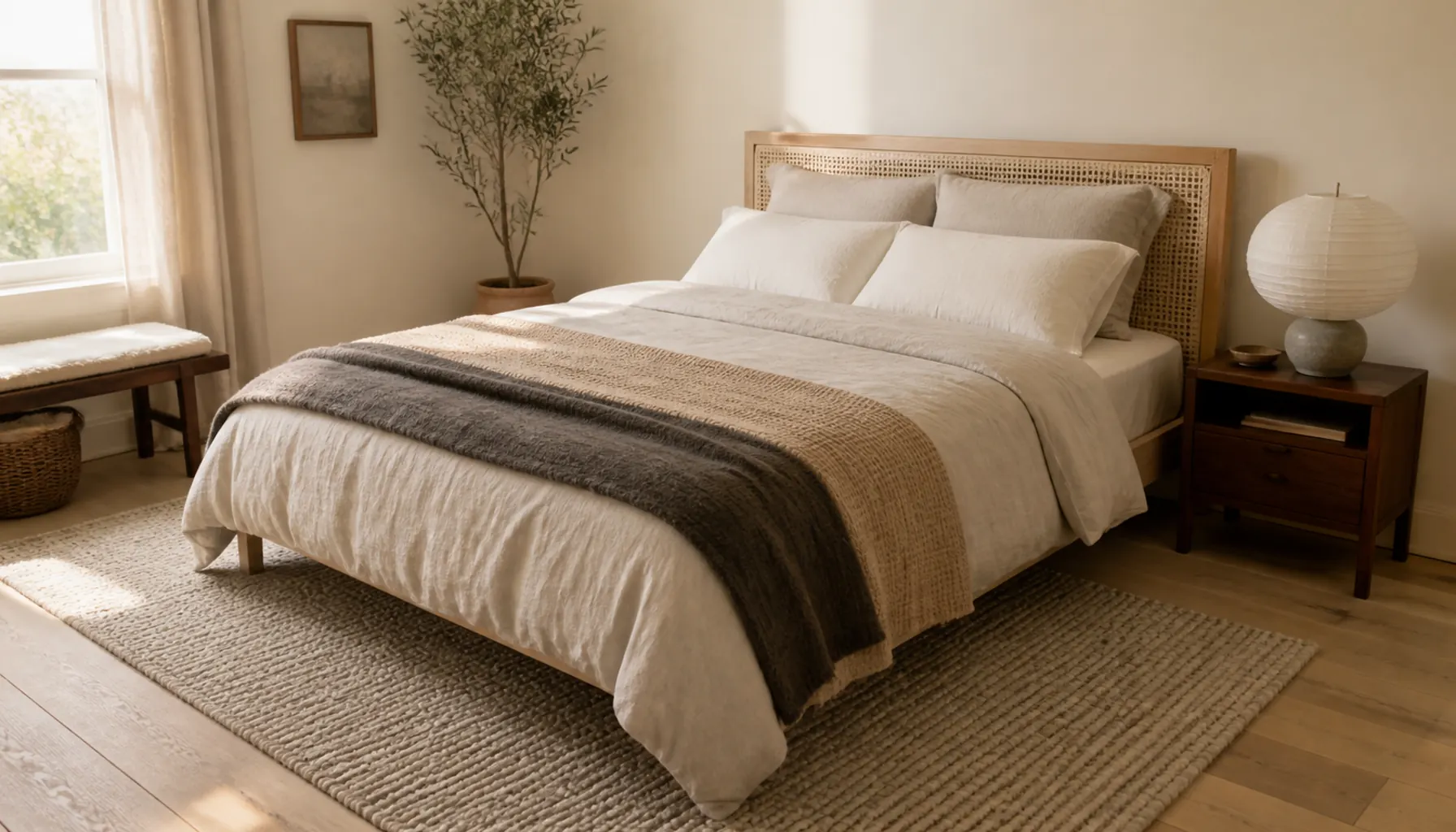
Start with the lightest, your sheets. Add a mid weight next: a cotton waffle blanket, a thin quilt, or a lightweight coverlet. Then the heaviest piece, usually a wool blanket or duvet, covering the lower two thirds of the bed. A folded throw across the foot is the optional fourth.
What makes it read as deliberate is turning the top sheet back over the mid layer, so a band of the lightest weight shows across the top. Three works year round. Four looks like storage unless your winters earn it.
Idea 3: Give Every Layer a Different Fiber
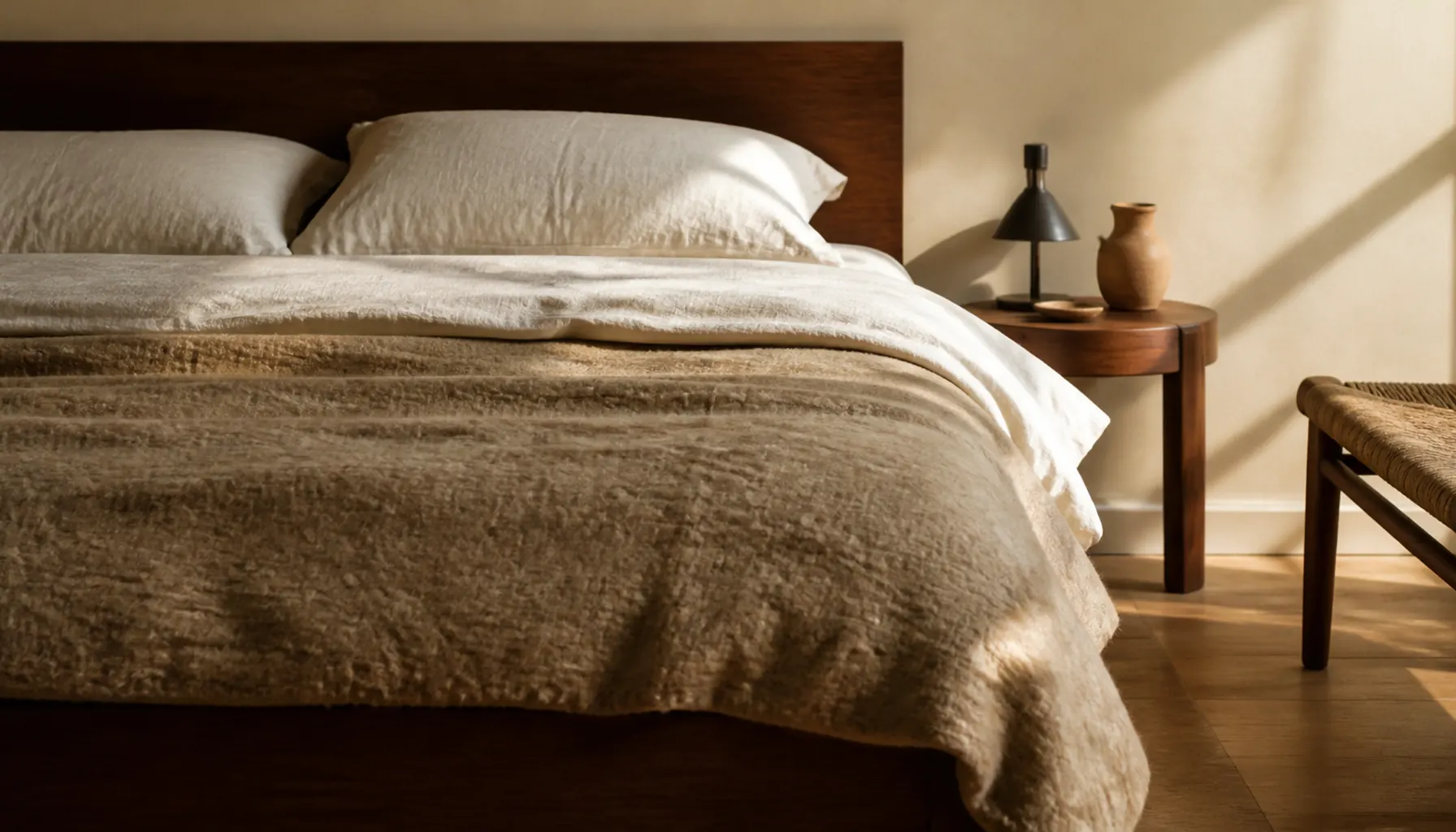
This is where most neutral bedrooms quietly go wrong. The layers are all there, all in the right sand tone, and all made of the same smooth cotton, so they blur into one thick surface.
Aim for one crisp fiber, one slubby, one napped. Cotton percale is the crisp one: flat, matte, slightly cool to the touch. Washed linen is the slubby one, with an irregular weave that catches shadow along every fold. Wool or brushed cotton is the napped one, soft enough to absorb light rather than bounce it.
Sateen is the fiber to leave out. Its sheen looks synthetic beside linen, even in an identical color.
Designer Note: If you spend on one layer, spend on the linen. It is what you touch nightly and see from the doorway, and it improves with washing.
Idea 4: Arrange Pillows You Will Actually Move
The five pillow wall in catalog photos gets dumped on the floor every night, which is why real bedrooms end up with three sad pillows and a dent.
Build it so only the front row moves. Two sleeping pillows lie flat in cases matching your sheets. Behind them, stand two shams in a different weave, linen with a flange being the easy version. One lumbar goes in front. Five pillows, two of which you touch.
Standing the back pair upright also lifts the visual top of the bed, which helps when the headboard is low. In a tight room, drop to one pair plus the lumbar; our small bedroom guide covers why fewer objects reads calmer when floor space is short.

Idea 5: Treat the Headboard as the Room's Largest Texture
Nothing else offers this much continuous surface at eye level, so whatever the headboard is made of sets the texture everything else answers to.
Oatmeal linen upholstery is the safe choice, because it shares a fiber with the bedding and softens sound in a room with hard floors. Cane webbing does the opposite job: the open weave lets the wall show through, so the bed takes up less visual mass in a small or dim room. White oak slats add a vertical rhythm a flat panel cannot.
Decide one thing before buying. A dark leather or espresso stained headboard becomes the deepest tone in the room, which changes the plan in idea seven. To build to your exact bed width, these DIY headboard ideas cover a few weekend versions.
Idea 6: Keep the Walls and Bedding a Half Step Apart
Beige on beige happens when people match. The wall gets painted in the bedding color, or close enough, and the bed dissolves into the surface behind it.
Separation is what you want, and it should come from value rather than hue. If the walls are a warm off white, put the bed a couple of steps deeper in oatmeal or sand. If the walls are already a mid tone mushroom, run the bedding lighter.
There is a quick check. Photograph the made bed against the wall and switch the shot to black and white. If bed and wall turn into one gray shape, you need more separation. Two clearly different grays and you can stop. Going further turns a tonal room into a contrast room.
Idea 7: Add One Deeper Tone to Give the Scheme a Floor
Warm neutral rooms float when nothing in them is dark. The eye has no bottom of the range to measure against, so the room reads washed out even though each piece looks fine on its own.
The anchor should be a deep neutral rather than a color: walnut, espresso stained oak, charcoal, or blackened metal. Choose one and repeat it twice at different heights, because a single dark object looks like a leftover. A pair of walnut nightstands plus a blackened metal curtain rod does it.
If you are pairing that with pale oak or pine you already own, our notes on mixing light and dark wood tones explain how to keep the two from arguing.
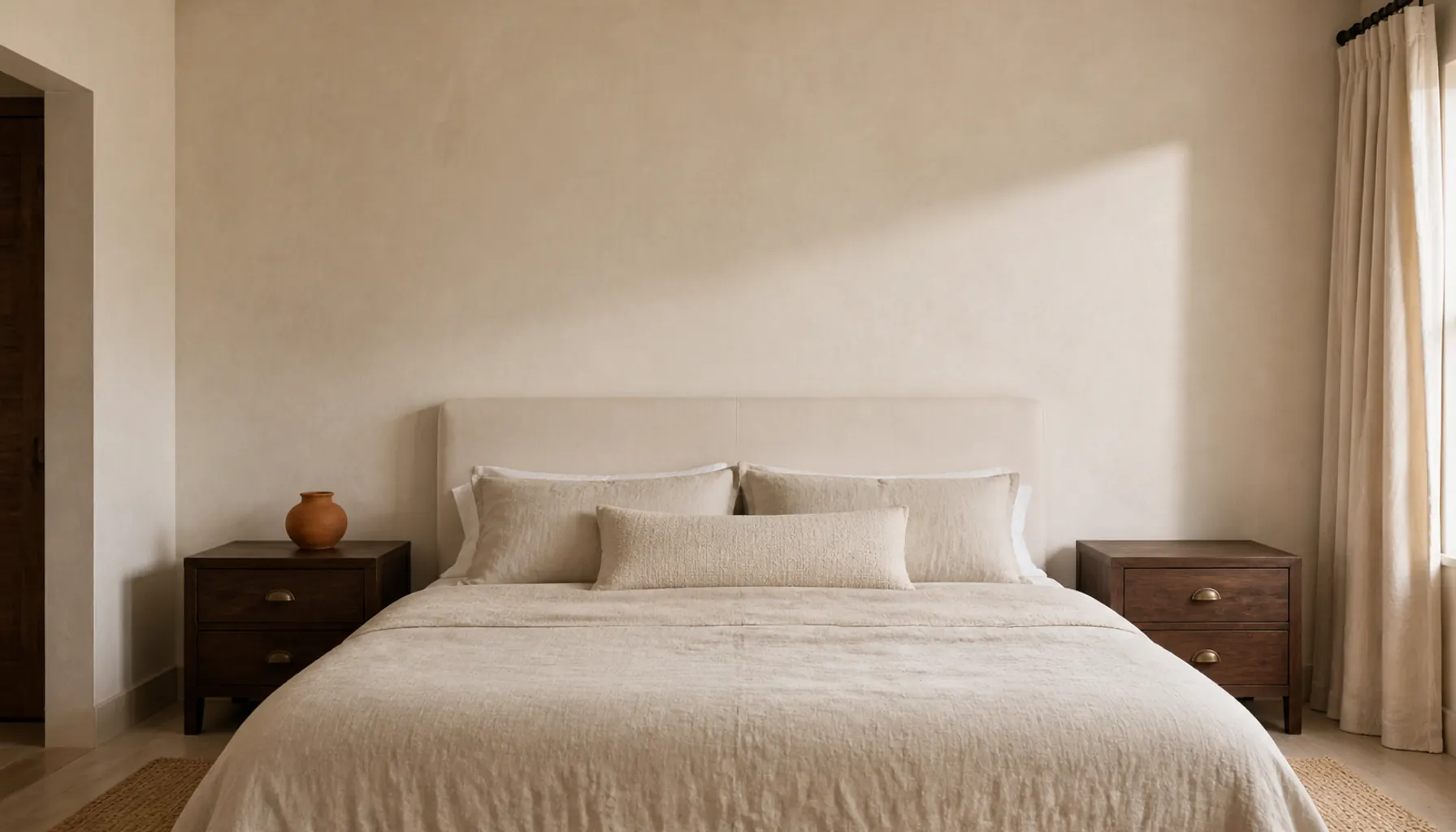
Idea 8: Buy Curtains Heavier Than You Think You Need
Sheer voile in a neutral bedroom is a wasted surface. It hangs limp, reads as nothing from across the room, and does no work at night.
Weight is what makes fabric fold, and folds are what turn a window into a column of texture. A cotton linen blend, wool flannel, or any lined panel holds a deep vertical pleat instead of flattening against the wall. Lining also blocks the streetlight at 2am.
Panels need to add up to roughly twice the width of the window, or they cover the glass without ever folding. Hang the rod high and wide, as covered in our window treatments guide, so the fabric runs close to floor to ceiling.
Budget Alternative: Adding a blackout lining to panels you already own costs a fraction of new curtains and fixes the weight problem at the same time.
Idea 9: Put a Rug Where Your Feet Actually Land
Most bedroom rugs are in the wrong place. A small rug centered at the foot of the bed photographs well from the doorway and does nothing for the person getting up.
Aim for wool underfoot on the sides you actually use. The generous version runs one large rug under the lower two thirds of the bed and past each side far enough that both feet land on it. The cheap version is a flatweave runner on each side, which still solves the cold floor.
Jute and sisal are the wrong fibers here. They look right in a neutral scheme and are unpleasant on bare feet at 7am. Layer wool over jute if you want both. Our guide to rug sizing has the placement logic.
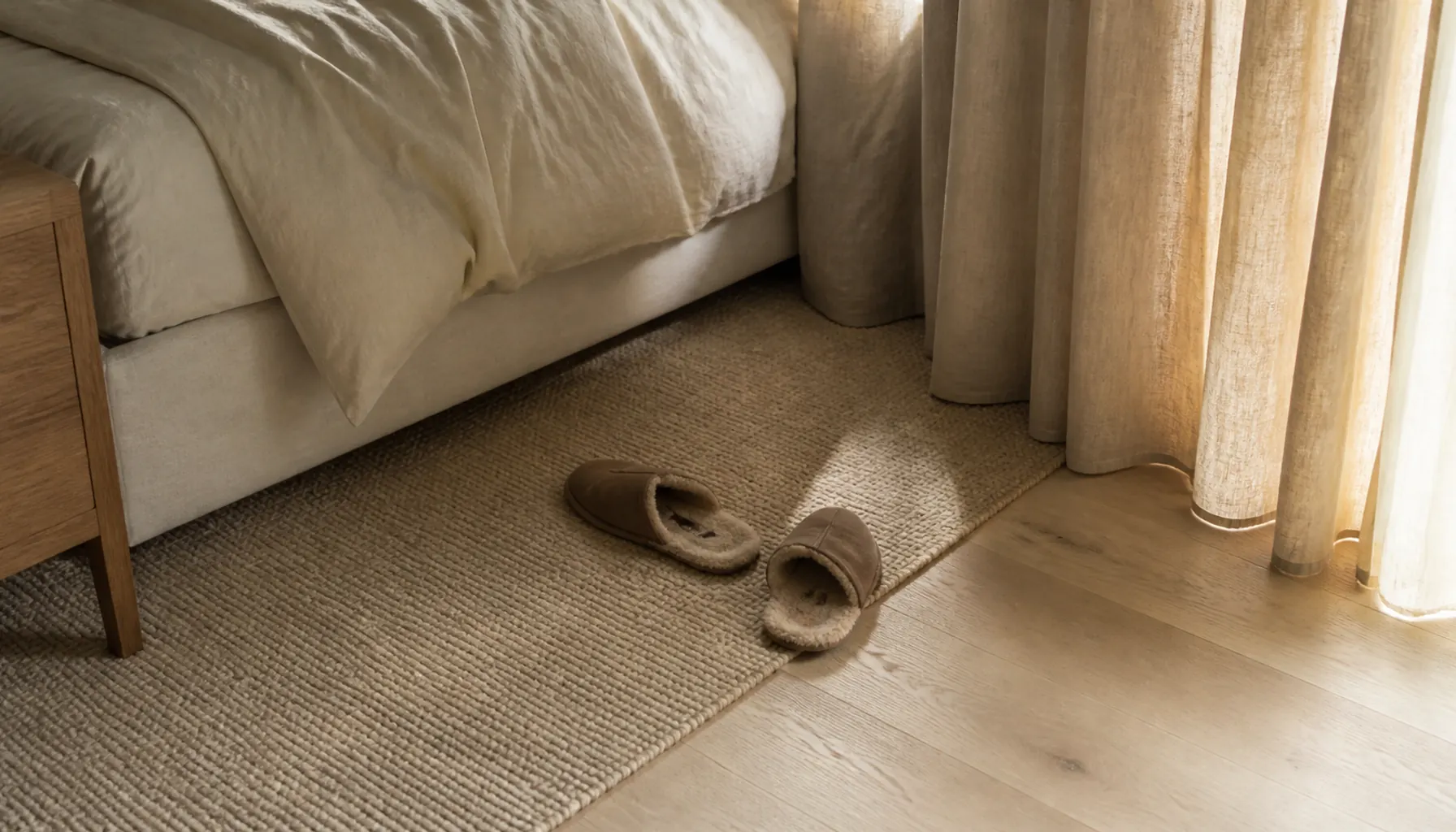
Idea 10: Keep the Bedside Matte and the Light Low
The nightstand gets more attention than its size suggests, because at night it is the brightest lit thing in the room and lit from directly above.
Choose a top with visible grain or a matte finish: oiled oak, travertine, unglazed ceramic, a woven stool. High gloss lacquer and glass throw the lamp back as a hard bright spot, the one hotspot in an otherwise soft room.
The lamp matters as much as the surface. A warm bulb around 2700K keeps linen looking right, and a linen or paper shade spreads light across the bedding instead of aiming it at the ceiling. Keep the shade low, roughly at seated shoulder height, so the pool of light falls on the bed. Cold overhead light undoes all of it, which is the first of these lighting mistakes that make rooms feel cold.
Idea 11: Let the Weave Carry the Pattern
Keep printed pattern almost entirely out of a room like this. Not because print is wrong, but because it competes with the only contrast you have left.
Surface texture is the substitute, and it comes in more forms than people use. Waffle weave on a blanket. Herringbone in a wool throw. Ribbed cotton on a cushion. Boucle on a bench seat, cane on the headboard, a nubby jute basket under the window. Each reads as a different surface in raking daylight without adding a color.
If you want a pattern, one is the ceiling and it should be tonal: a faded stripe in two shades of the same sand. Three patterns here reads busier than three patterns in a colorful room, because nothing else gives the eye somewhere to rest. Our beginner's guide to mixing textures is built around that trade.
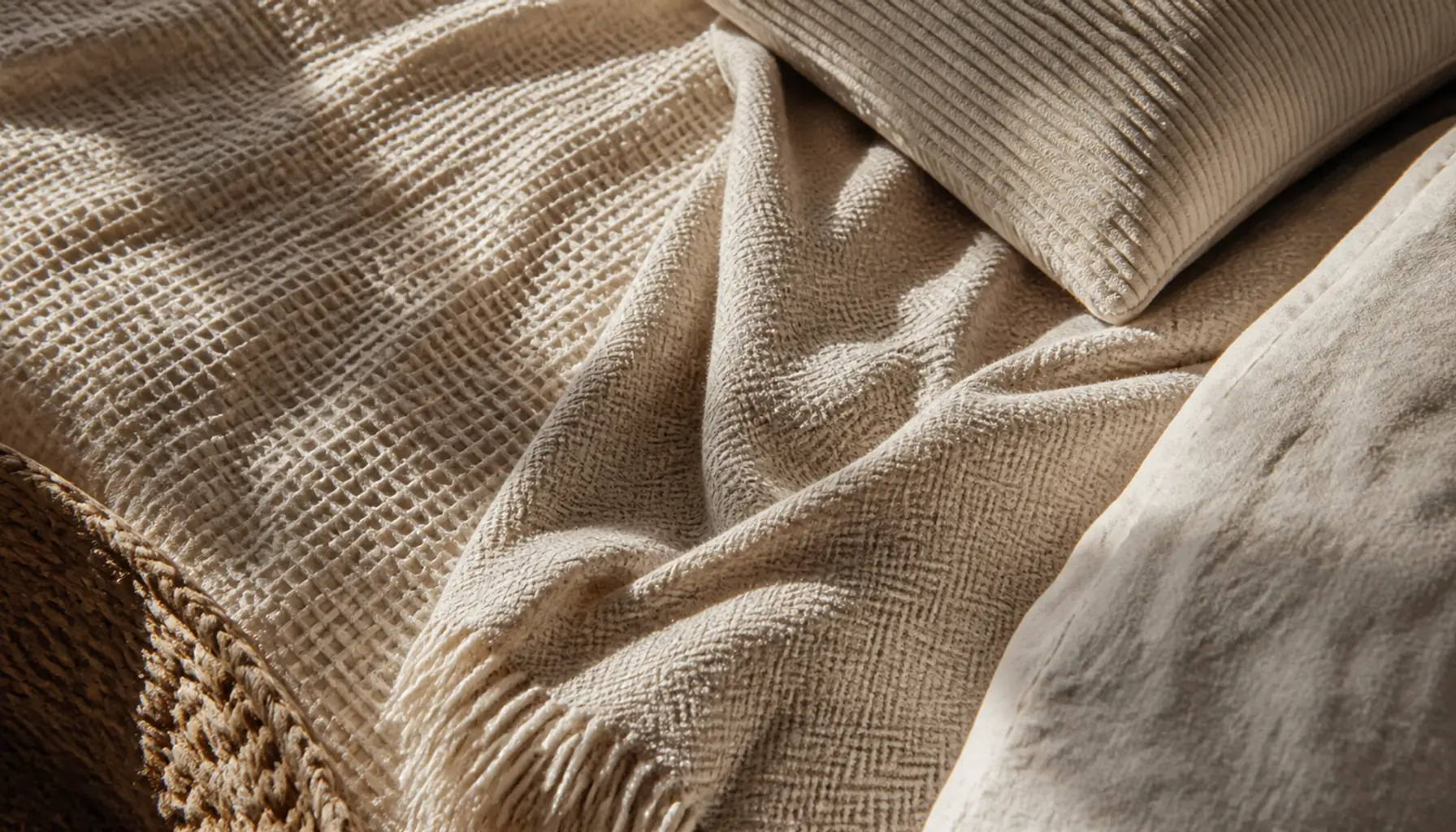
Idea 12: Add One Accent and Let It Repeat
A room with no chromatic note can feel unresolved rather than restful. One accent fixes that, and one is the number.
Pick something muted and on the warm side: dusty sage, terracotta, rust, ochre, faded olive. Saturation is what breaks a neutral scheme, not the color itself, so a chalky sage behaves and a bright emerald does not.
Then keep it small and repeat it two or three times: a cushion, a ceramic on the dresser, the mat around a piece of art. At that scale it reads as a decision. Put the same tone on a wall or a full set of curtains and you no longer have a warm neutral bedroom, you have a sage bedroom. For a warmer version of the same restraint, see how we handle terracotta against neutrals.
Common Mistakes to Avoid
Buying a bedding set. Matching sets are one fiber in one weave, which is the opposite of what a layered bed needs. Buy the layers separately.
Treating optical white as a neutral. Bright white next to warm oatmeal makes the oatmeal look dirty. If you want white here, make it a warm white.
Letting the accent grow. Two cushions become four, then a throw, then curtains, and the neutral scheme is gone. Count them occasionally.
Skipping the dark tone because the room is small. A small bedroom needs the anchor more, not less. It can be a lamp base and a picture frame rather than furniture.
Expert Tips for Pulling the Look Together
Squint at the finished room from the doorway. Squinting strips detail and leaves value, so anything that dissolves into its background needs separating and anything that jumps out is your accent whether you meant it or not.
Repeat one fiber in two places at different distances. Linen on the bed and linen at the window ties the two sides of the room together more quietly than matching colors would.
Check the room at night with only the lamps on before committing to paint. A neutral that behaves in daylight can turn yellow or gray under a warm bulb, and you see the bedroom that way more often than at noon.
Frequently Asked Questions
What is the difference between a warm neutral and a cold neutral?
The undertone. Warm neutrals have a yellow, orange, or red base, which shows up as a faint golden or pinkish cast beside plain white paper. Cold neutrals have a blue, violet, or green base and look cleaner next to that paper. Both get called beige, taupe, or greige, so the name on the tin tells you very little.
How many layers should a bed have?
Three is the reliable number: sheets, a mid weight blanket or quilt, and a heavier duvet or wool blanket. A folded throw makes four. What matters more than the count is that each layer is visibly heavier and a different fiber than the one below, so the stack reads as separate pieces rather than one lump.
Can a warm neutral bedroom work without wood furniture?
Yes, but you still need the deep tone from somewhere. Charcoal or blackened metal does the same job as walnut: a black metal frame, dark lamp bases, an iron curtain rod. Painted furniture in a deep mushroom or espresso works too. Something in the room has to be clearly the darkest thing in it.
Is gray paint a bad choice for a bedroom?
Not automatically, but it is unforgiving. Gray with a warm base can be lovely. Gray with a blue or violet base tends to look flat and slightly clinical in the low, warm light a bedroom actually gets, and no amount of cream bedding rescues it. If your walls are already cool gray, warm the room with wool, deep wood tones, and warmer bulbs before you repaint.
Where to Start
Start with the undertone, because it decides everything after it. Hold three samples against white paper in your own bedroom, pick the one that looks faintly golden rather than clean, and let that be the family for the paint, the bedding, and the curtains.
Then buy the two largest textiles, the curtains and the rug. They cover more surface than anything else and are the hardest pieces to match to later.
The bed layers can come together slowly, one fiber at a time, which is also the cheapest way to do it. A linen duvet cover this month, a thrifted wool blanket next, a pair of shams in a different weave after that. The room gets warmer with each layer instead of waiting on one big purchase.
One useful home email a month
Real ideas to make your home work better. No spam, easy unsubscribe.