14 Laundry Room Organization Ideas for Small Spaces
Make a cramped laundry room work harder with 14 real organization ideas, from stacked machines to a fold-down ironing station and closet nooks.

· 14 min read
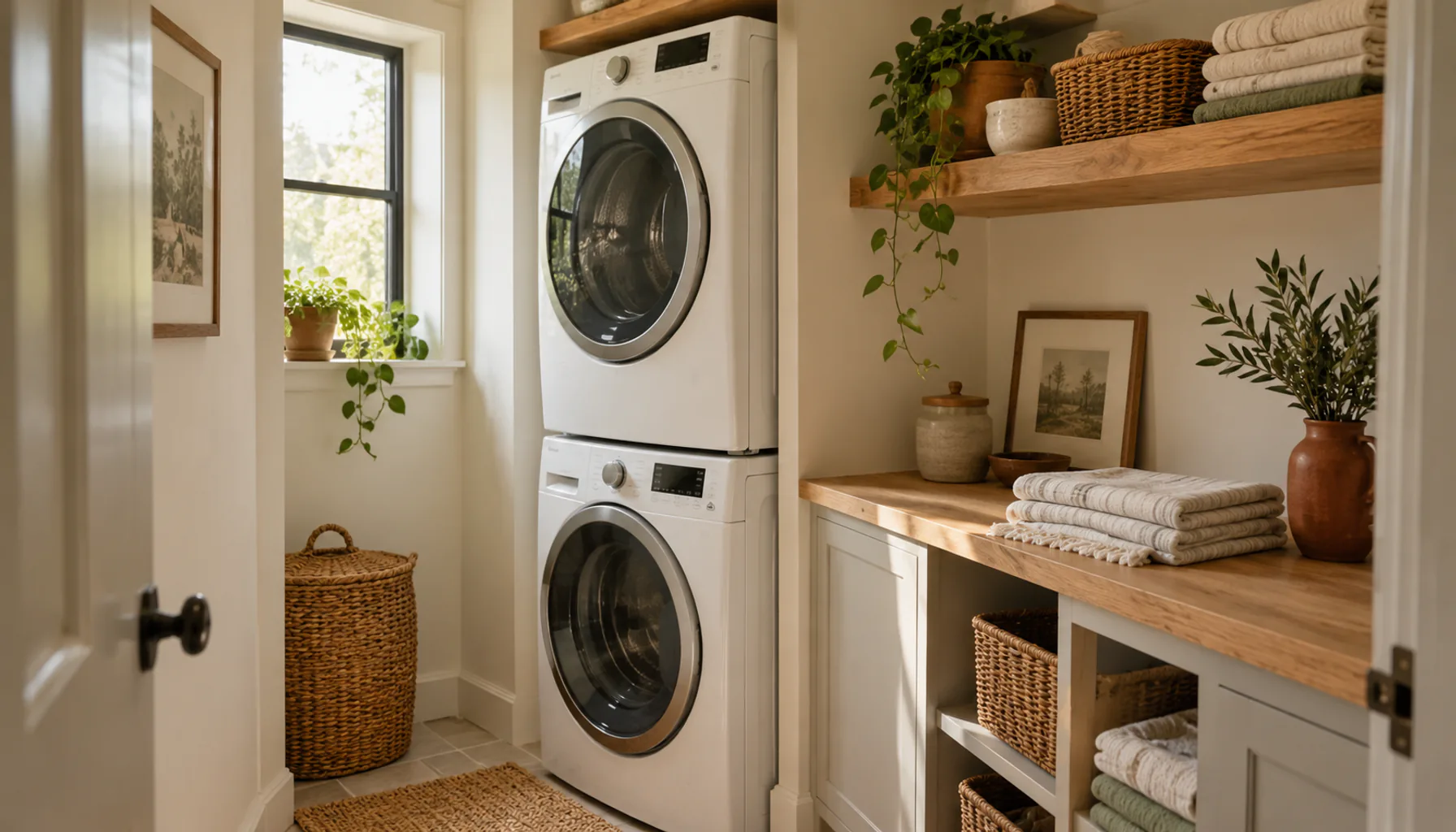
A small laundry room usually isn't short on ideas, it's short on floor space. Most laundry closets and stacked nooks run 5 to 7 feet deep and barely 3 feet wide, which rules out a lot of what works in a dedicated mudroom. The fixes that hold up in that footprint lean vertical, foldable, or built into a wall you're already using. These 14 ideas focus on function first: somewhere to fold, somewhere to sort, a spot to press a shirt, and somewhere for everything else to live that isn't the floor.
Key Takeaways
- Stacking the washer and dryer is the single biggest space gain, often freeing 6 to 8 square feet of floor.
- A countertop over the machines turns dead space into the folding surface most small laundry rooms don't have.
- Vertical storage beats floor storage. Shelving above the machines holds more than any cart or basket on the ground.
- Separate sorting bins save time at wash day, since clothes go in presorted instead of needing a second pass.
- A pull-out or hidden hamper keeps a shared or guest-visible space from feeling like a hamper graveyard.
- One consolidated supply station beats scattered bottles and boxes on top of the machines.
- A closet laundry nook can be fully concealed with bifold doors or a curtain.
- A fold-down ironing station skips the floor-standing board entirely in a room that can't spare it.
- A narrow vertical slot for cleaning tools keeps the broom and mop handle from leaning against the machines.
14 Laundry Room Organization Ideas Worth Trying
Idea 1: Stack the Washer and Dryer to Reclaim the Floor
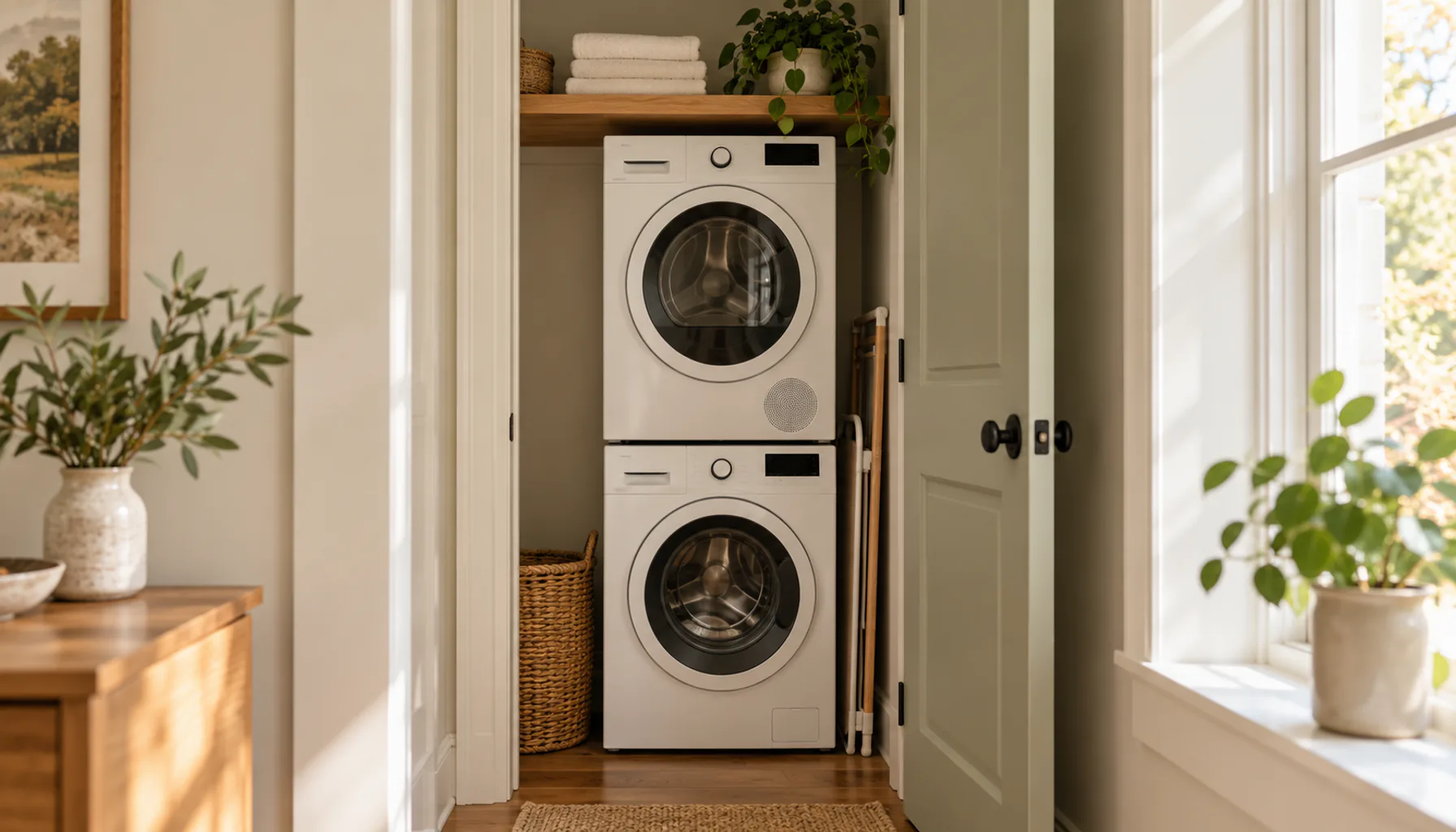
If your laundry room is a true side-by-side footprint, stacking is the one change that creates usable floor space instead of just rearranging what you already have. A stacked pair frees up roughly the width of one machine, which in a 30-to-36-inch-wide closet is often the difference between no counter and a narrow one.
Not every machine can stack. Check that the dryer is listed as stackable by its manufacturer and use the matching stacking kit rather than improvising with plywood or shims. Front-load washers are built for this; top-load washers generally aren't rated to have a dryer stacked above them. If you rent, confirm with your landlord first.
This works best for one- or two-person households doing small loads. Families running large loads may find a stacked dryer's reduced capacity frustrating, so weigh that against the space savings.
Idea 2: Add a Counter Over the Machines
A fitted countertop spanning side-by-side machines gives you a folding surface that doesn't exist in most small laundry setups. Butcher block, laminate, or a cut piece of quartz all work, as long as it sits on cleats or brackets rather than resting loose, since front-loaders vibrate during the spin cycle.
Leave a small gap, usually half an inch, between the counter and each machine's control panel so the lid or door still opens fully. Top-loading machines need the top clear, so this idea doesn't apply to them; stacking (Idea 1) is the better route there. A counter here only works, though, if it isn't immediately covered in detergent bottles.
Idea 3: Install a Fold-Flat Wall-Mounted Drying Rack
Floor-standing drying racks eat exactly the square footage a small laundry room can't spare. A wall-mounted rack that folds flat against the wall solves this without giving up air-drying space entirely. Mount it where a fully extended rack clears your head, usually 5 to 5.5 feet up, and anchor into a stud since a loaded rack with wet towels is heavier than it looks.
Pick a spot with airflow, near the dryer vent or a window, rather than a dead corner where damp fabric takes longer to dry. For renters, a tension rod mounted between two walls is a no-drill alternative, though it holds less weight.
Idea 4: Use an Over-the-Door Organizer for Small Supplies
Pods, dryer sheets, and stain removers are small, numerous, and easy to lose track of on an open shelf. An over-the-door fabric or wire organizer, hung on the laundry room door or a nearby closet door, keeps these in clear view without using any counter or shelf space. Clear pockets work better than solid fabric here, since you want to see what's running low without pulling each one out. It's the same small-items problem bathroom organization in a shared space solves with similar over-door storage.
It's also the easiest idea here to add without tools, which makes it a good starting point if you're not ready to commit to shelving or a counter yet.
Idea 5: Fill the Gap Between Machines With a Rolling Cart
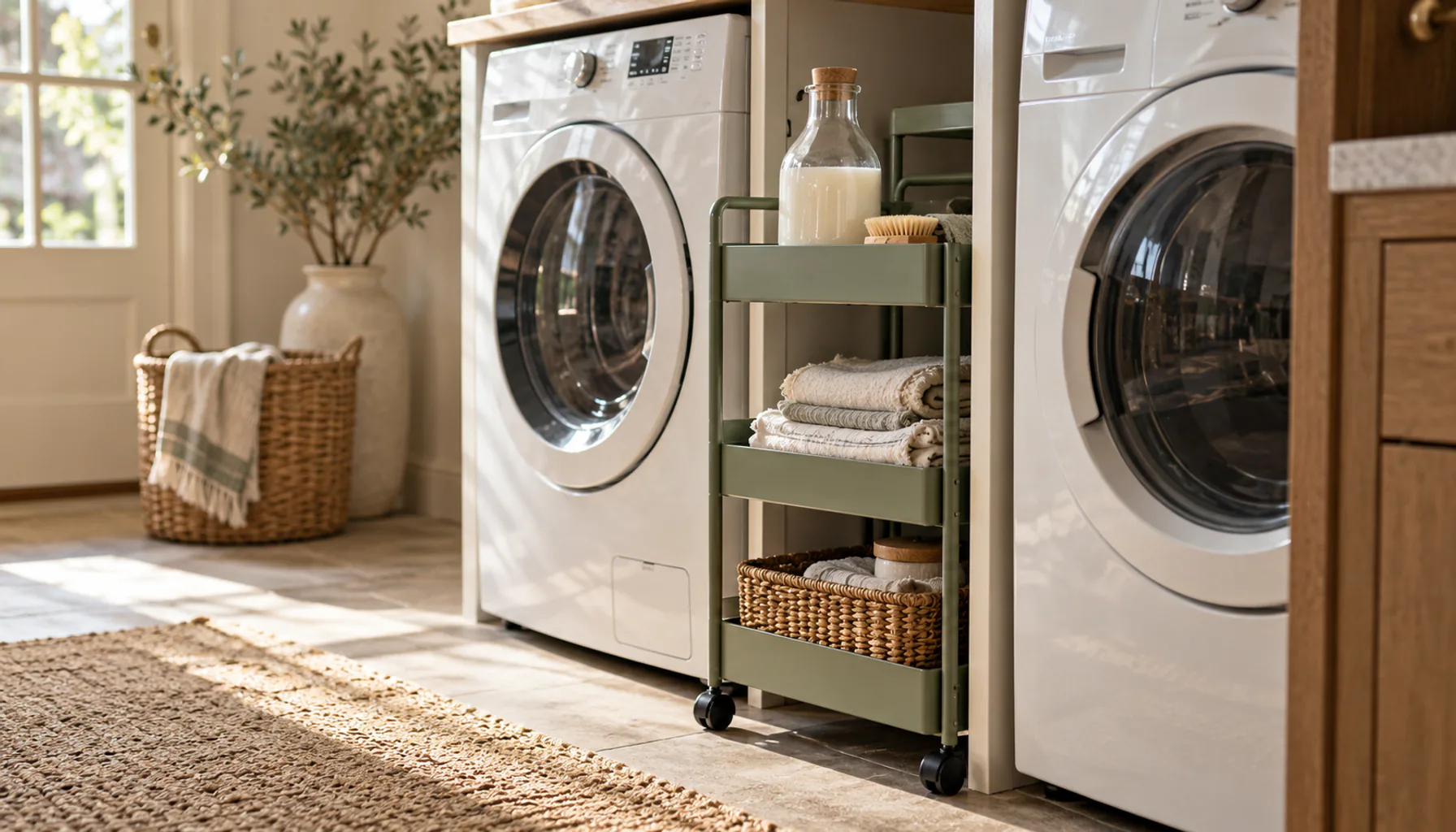
Most side-by-side pairs have a narrow gap between them, usually 2 to 4 inches, too small to be useful and too big to ignore. A slim rolling cart made for this gap turns it into slide-out storage for detergent, stain treatments, or a basket of socks waiting to be matched.
Measure the actual gap before buying. A cart even half an inch too wide won't fit, and one much narrower wastes the extra space. If your machines sit flush with no gap, skip this rather than forcing a cart elsewhere where it blocks foot traffic.
Small-Space Tip: A rolling cart only earns its keep if you can actually roll it out. If the gap backs onto a wall with less than a foot of clearance in front, measure that approach space too.
Idea 6: Add Vertical Shelving Above the Machines
The wall above a washer and dryer is usually the most underused space in the room. Open shelves, floating or bracketed, hold bulk detergent, overflow paper towels, and seasonal items that don't need daily access. Keep the lowest shelf reachable without a step stool for anything you use weekly, and push true overflow stock to the top.
Closed cabinets do the same job with a cleaner look if the room is visible from a hallway, but cost more and take longer to install. Grouping by how often you reach for something, not just by category, is the same zoning logic behind organizing a kitchen by how you cook.
Idea 7: Sort With Labeled Bins Instead of One Hamper
A single shared hamper means sorting happens twice: once when you dump it out, and again when you separate lights from darks. Three or four labeled bins, sized to your actual laundry volume rather than oversized ones that just collect more before a load, let sorting happen as clothes go in, not on wash day.
Clear or light-colored bins work better than solid dark ones since you can see what's piling up without lifting a lid. Label by category rather than by family member if multiple people share the space, since category is what determines the load. If bins tend to overflow, the same habit behind the 15-minute declutter method applies here too.
Idea 8: Build In a Pull-Out Hamper
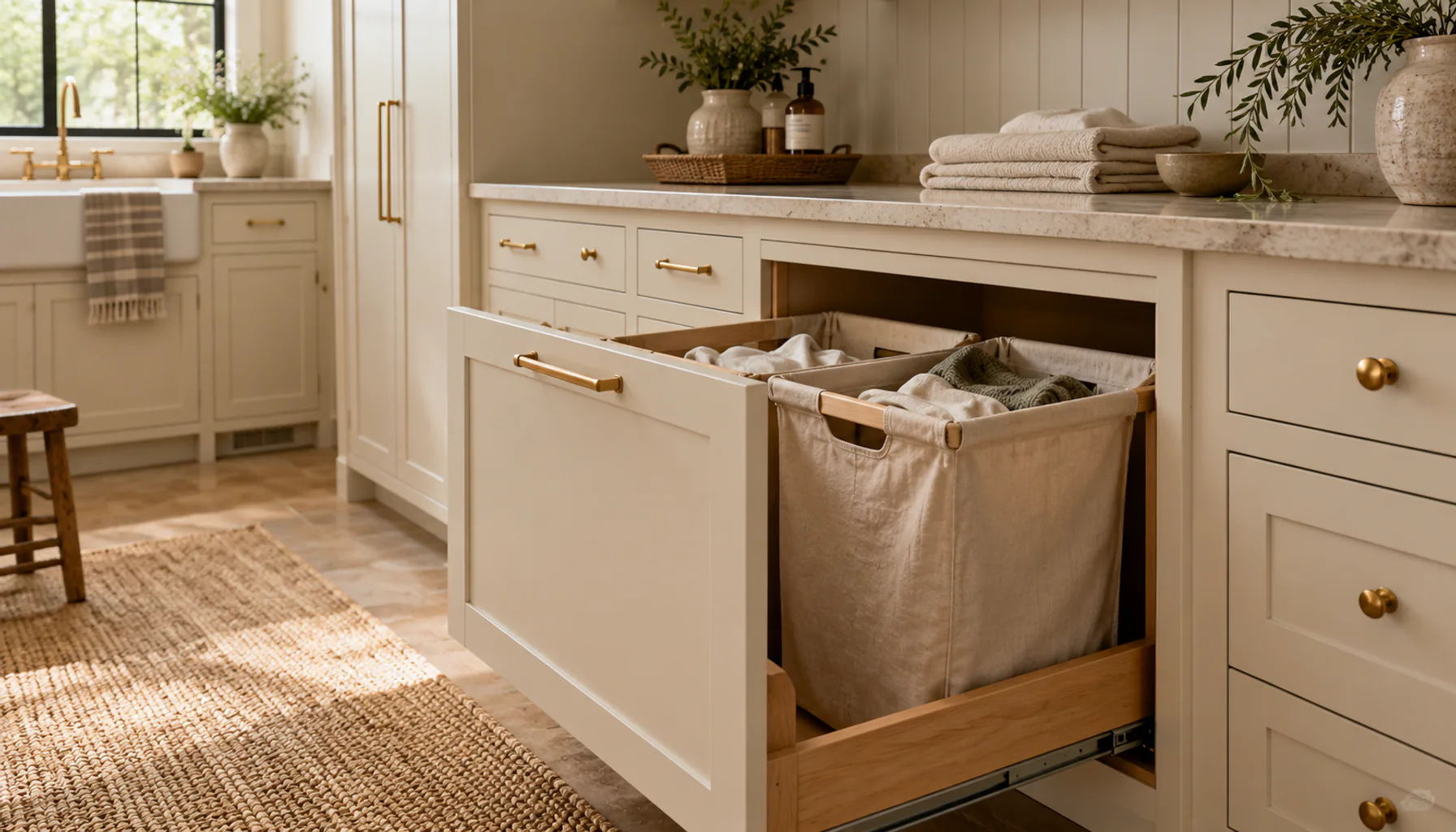
If the laundry room doubles as a mudroom or half-bath, visible hampers can make the whole space feel untidy even when it's clean. A pull-out hamper built into base cabinetry or tucked under a counter hides the sorting bins behind a door or drawer front while keeping them just as accessible.
It's a bigger project than most here, usually needing a cabinet box or a retrofit kit sized to an existing opening, and it's worth it specifically in shared or guest-visible spaces. In a closet-only nook with a door that closes, open bins (Idea 7) do the job for less. Our guide to hidden storage furniture hacks for small apartments covers the same concealment trade-off in other rooms.
Idea 9: Add a Hanging Rod for Air-Dry and Fresh-Out-of-Dryer Items
A short hanging rod, even just 18 to 24 inches, gives you somewhere to hang shirts straight from the dryer before they wrinkle, or to air-dry items that can't go in the machine. Mount it above the counter from Idea 2, or on a side wall, so it doesn't compete with folding space.
Without this, fresh laundry either piles on the counter waiting to be hung elsewhere, or sits wrinkling in the dryer. Keep the rod short enough that a full load of hangers doesn't block the path between the machines and the door.
Idea 10: Keep a Stain-Treatment Caddy Within Arm's Reach
Spot-treating works best done immediately, not after walking the stained item to a cabinet across the room. A small caddy or tray on the counter or a low shelf next to the machines keeps a stain stick, a spray bottle, and a soft brush together and visible. The point isn't capacity, it's removing friction at the exact moment you need these items.
Keep the caddy small on purpose. If it grows to include every cleaning product in the house, it stops being a quick-grab station and becomes another cluttered surface.
Idea 11: Convert a Hallway Closet Into a Concealed Laundry Nook
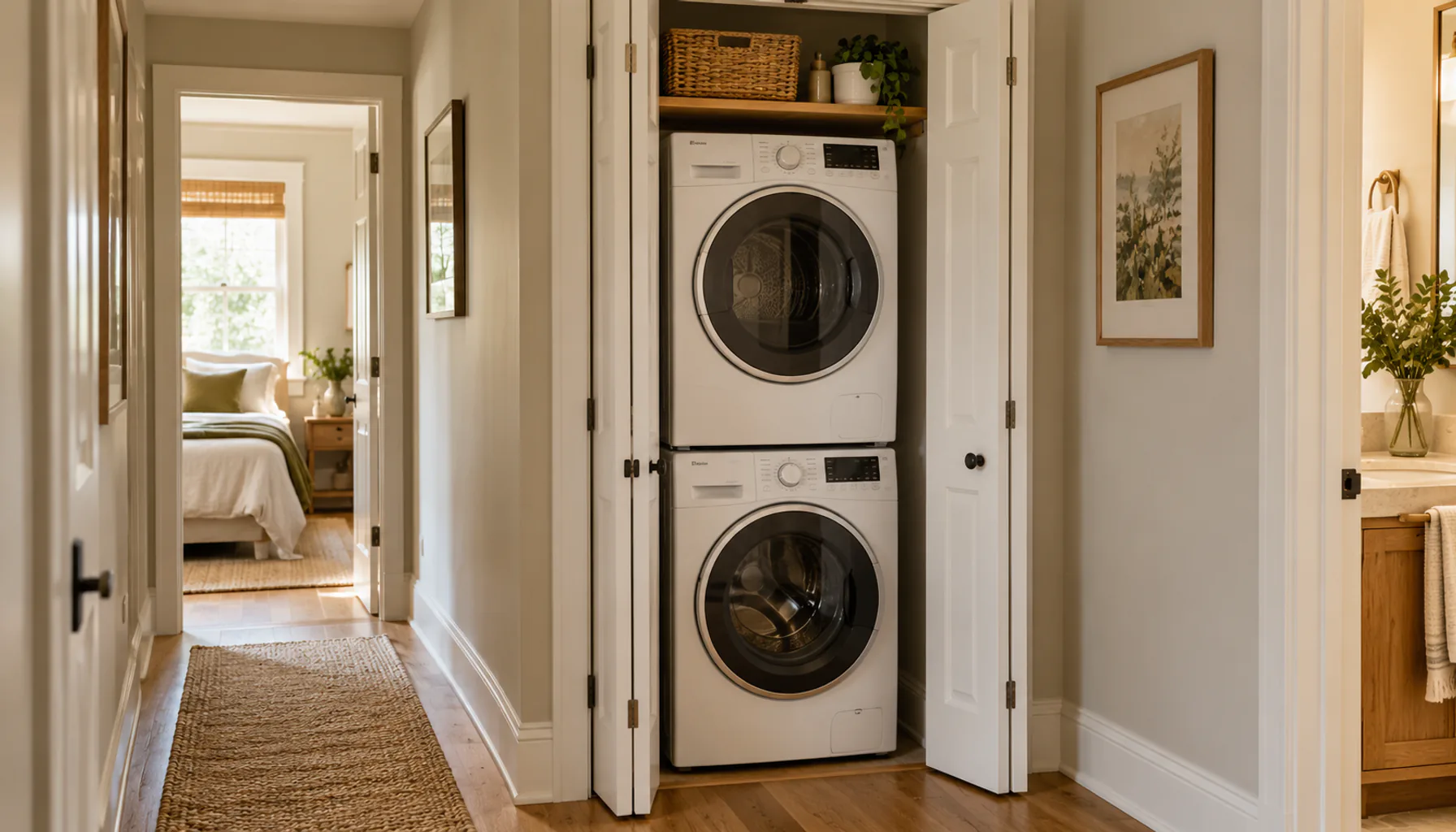
If you don't have a dedicated laundry room, a hallway or linen closet fitted with a stackable unit and bifold doors or a curtain can function as one without changing how the hallway feels day to day. This works especially well in apartments and older homes where plumbing can be routed to a closet near the kitchen or bathroom.
Bifold doors give full access while doing laundry and a clean, closed look the rest of the time; a curtain is the cheaper, renter-friendly version. Either way, confirm the closet can have proper venting and water hookups before committing, since retrofitting plumbing is the expensive part, not the doors. For a broader look at reclaiming closets for function, see our guide to closet organization systems that actually last.
Idea 12: Consolidate Odor and Lint Control Into One Bin
Lint rollers, a dryer-lint trash bin, dryer sheets, and baking soda for odor control tend to end up scattered across whatever flat surface is free. Grouping all of it into one labeled bin near the dryer means there's one place to check instead of three or four.
It's a low-effort idea compared to the others here, but it solves a real small annoyance: needing a dryer sheet and not remembering which shelf they're on. Put the bin where you'll actually open the dryer door, not on a shelf across the room.
Idea 13: Build In a Fold-Down Ironing Station
A freestanding ironing board is one of the biggest floor-space offenders in a small laundry room, and it's rarely stored where it's used. A wall-mounted board that folds down from a shallow cabinet, or a drawer-front version that pulls out flat, gives you a dedicated pressing surface that disappears when you're done with it.
Mount it at a height that works standing, usually around 34 to 36 inches to the folded-down surface, and leave enough swing clearance for the board to drop fully without hitting the machines or a side wall. Pair it with an outlet nearby so the iron isn't running on an extension cord across the room. This is a bigger install than most ideas here, closer in effort to the hanging rod in Idea 9 than to a bin swap, but it's worth it in any laundry room where pressing currently means dragging a board out from a closet down the hall.
If a built-in unit isn't in the budget, a slim over-the-door ironing board hanger is the renter-friendly version. It still gets the board off the floor, just without the fold-down mechanism.
Idea 14: Carve Out a Narrow Vertical Slot for Cleaning Tools
The laundry room is also where the broom, mop, and handheld vacuum usually end up, leaned against a machine or wedged behind the door where the handle slides down every time something opens. A gap as narrow as 6 to 8 inches, fitted with a tension rod and spring clips or a slim wall-mounted tool rack, keeps long-handled tools upright without needing a dedicated closet.
Mount it on the same wall as the shelving from Idea 6, not near the dryer vent, so nothing blocks airflow. It's one of the cheapest fixes here, usually under $20 for wall clips, and it solves a small daily annoyance rather than a big storage problem.
Common Mistakes to Avoid
- Buying a stacking kit that doesn't match the dryer model. Mismatched kits can void warranties and create real stability issues. Confirm compatibility with the manufacturer first.
- Mounting shelves without checking for studs. A shelf loaded with detergent jugs is heavier than it looks; drywall anchors alone will eventually fail.
- Oversizing the hamper bins. Bigger bins just mean laundry piles up longer. Size bins to roughly a week's worth for your household.
- Blocking the dryer vent path with shelving or a hanging rod. Keep anything you install clear of the vent hose.
Expert Tips for a Laundry Room That Actually Works
Put what you touch every load, detergent, stain stick, the hamper you're sorting into, at or below shoulder height. Reserve the top shelf for anything you touch less than once a month, since that's the height you'll resent reaching for daily items. And if the room is narrow, use one wall fully for storage and leave the opposite wall clear. Storage crammed onto both sides of a 3-foot-wide room makes the space harder to use than one well-organized wall.
Frequently Asked Questions
How much space do I need for a stacked washer and dryer?
Most stacked units need a footprint of about 27 to 30 inches wide and 30 to 34 inches deep, plus roughly 6 inches of clearance behind for venting and hookups. Check your specific model's installation guide, since compact and standard units vary.
What's the cheapest way to organize a small laundry room?
Labeled sorting bins and an over-the-door organizer are the lowest-cost starting points, both under $50 total in most cases. Neither requires installation, and together they solve the two most common small-laundry-room problems: unsorted clothes and loose small supplies.
Can I put a countertop over a top-load washer?
No. Top-load machines need their lids fully clear to load and unload, so a fixed counter over the top isn't practical. A side table or rolling cart next to the machine works better for that layout.
How do I add laundry to a hallway closet without a dedicated laundry room?
Confirm the closet can be plumbed for water supply and drainage, and can have proper dryer venting, before buying any equipment. A licensed plumber can usually tell you in one visit whether the retrofit is straightforward or will require opening a wall.
Is a hidden pull-out hamper worth the cost over open bins?
It depends on visibility. In a closet-only nook with a door, open bins work fine and cost far less. In a laundry room visible from a kitchen or hallway, a concealed pull-out hides clutter in a way open bins can't.
How do I keep a small laundry room from feeling cluttered?
Consolidate small supplies into as few containers as possible (Ideas 4, 10, and 12 all do this), and keep one wall clear of storage entirely so the room has a visual resting point. A fully organized room where every wall is covered can still feel busy.
Making the Space Work Harder Than Its Square Footage
None of these ideas require a full renovation. Most are a shelf, a bin swap, or an afternoon project, and the ones that do take more work, stacking the machines, converting a closet, or building in a fold-down ironing station, pay off because they reclaim floor space rather than just reorganizing what's already there. Start with whatever actually bothers you day to day, whether that's nowhere to fold or a pile of unsorted clothes, and build out from there. It's also a natural fit for your next seasonal home reset, since laundry supplies are easy to overhaul at the same time. For more ways to stretch storage in a tight footprint, see our guide to small apartment storage ideas that actually work.
One useful home email a month
Real ideas to make your home work better. No spam, easy unsubscribe.