12 Entryway Decor Ideas With Natural Materials That Last
Entryway decor ideas in wood, stone, wool, and rattan, with honest guidance on which natural materials survive wet shoes, grit, and a narrow hallway.

· 13 min read
An entry is the roughest room in the house for materials. Wet shoes land on the floor, damp coats press against the wall, bags scrape the paint at hip height, and grit travels across everything in the first few feet. Natural materials do well there, but not all of them, and not everywhere. Solid wood, stone, wool, and cane hold up. Jute, sitting where boots drip, does not. The ideas below are organized by material rather than by object, so you can decide what the bench, the hooks, the mirror, the runner, and the walls should be made of before buying any of it. Most of it works in a rental.
Key Takeaways
- Split the entry into a wet zone and a dry zone. Hard materials where shoes land, soft fiber after that.
- Jute belongs in a dry entry only. It absorbs water, stains, stiffens, and cannot be wet cleaned.
- Solid wood beats veneer at a door, because water swells particleboard edges and lifts edge banding within a season.
- Cane and open weave let damp shoes dry, while a sealed cabinet holds the smell.
- Texture only shows under angled light. A fixture pointing straight down flattens limewash and wood grain.
- Keep the palette tight: two wood tones, one stone, one fiber, one metal.
12 Natural Material Entryway Ideas Worth Trying
Idea 1: Give the Threshold a Hard Grit Zone
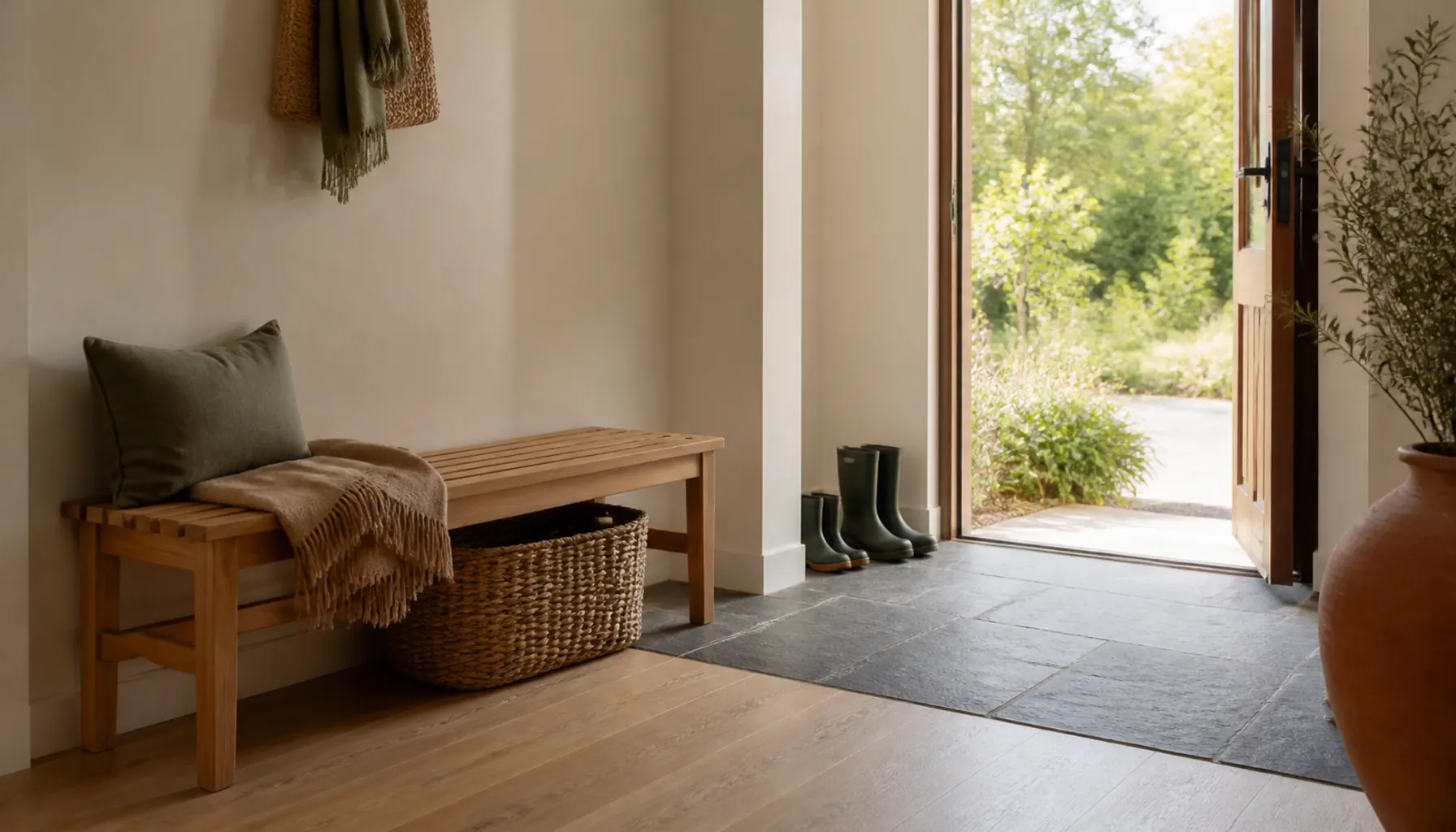
The first stretch of floor inside the door takes almost all the abuse, so treat it as a separate material from the rest of the entry. Slate, unglazed quarry tile, or a stone slab wipes clean, tolerates salt, and dries without holding a stain. A coir mat does the other half of the job: the stiff bristles scrape grit out of a boot tread instead of soaking it up, and coir dries fast enough not to sour.
If the floor is not yours to change, a slate or stoneware boot tray with a raised lip gives the wet zone a border. Anything that drips lives inside the tray, and the softer materials start where the tray ends. That single division prevents most entry material problems.
Idea 2: Choose a Bench in Solid Wood, Not Veneer
A bench earns its space because sitting down to deal with boots beats balancing on one leg, but the material decides whether it survives. Solid oak, ash, or beech can be sanded and re-oiled when a wet heel leaves a mark. A wood-look wrap over particleboard cannot: water wicks into the bottom edge, the core swells, and the edge banding peels away from the corner.
Look for a slatted seat rather than a solid panel, since water falls through the gaps and the wood dries on both faces. An oil or hardwax finish is repairable by hand, while a factory lacquer has to be stripped.
Set the seat at chair height so lacing a boot is not a squat, and leave the base open for shoes. A bench works best inside a routine, which is where an entryway setup built for busy mornings comes in.
Idea 3: Hang a Wood Peg Rail and Pick the Metal Carefully
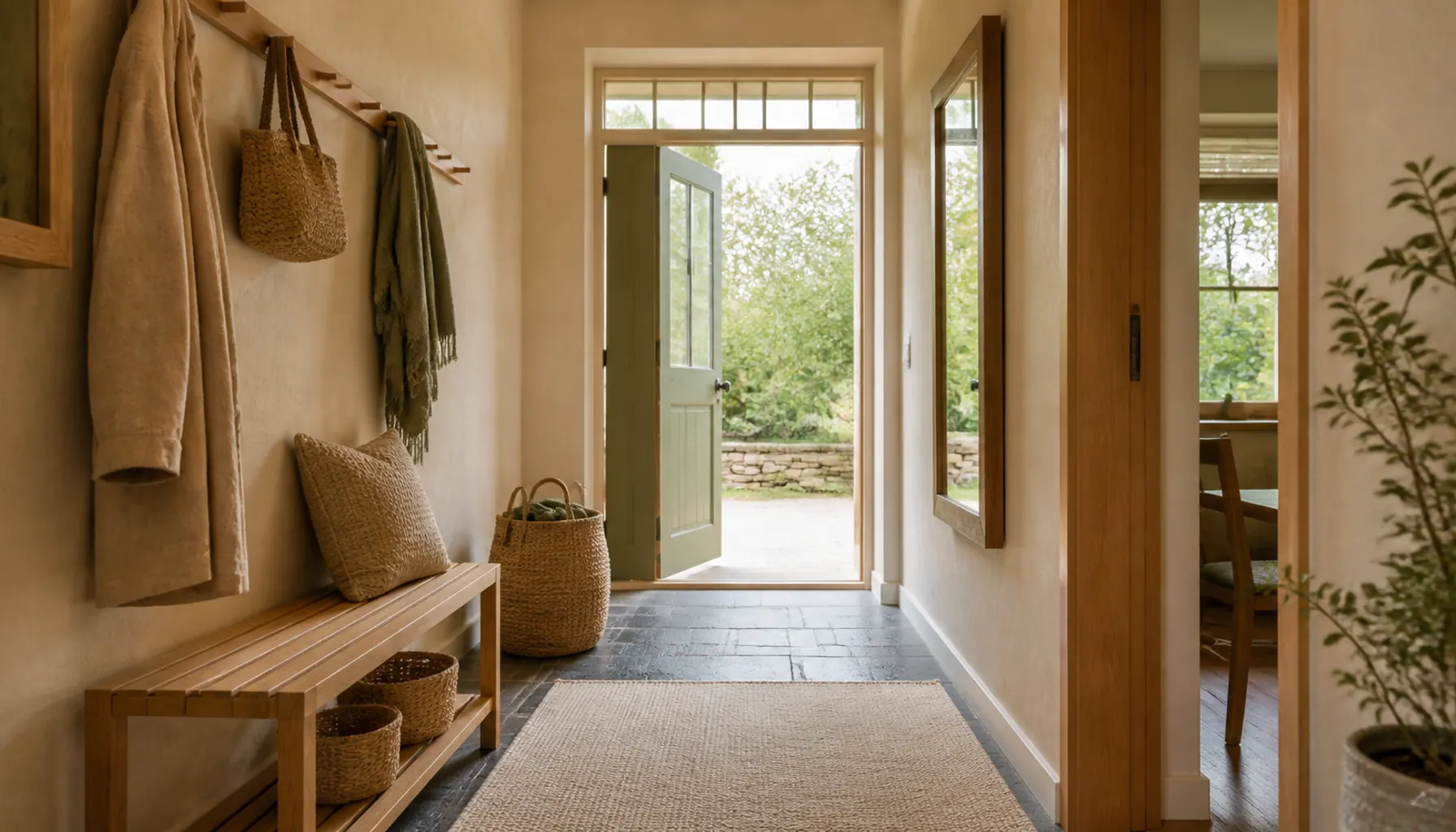
A wooden peg rail does something a scatter of individual hooks cannot: it reads as one horizontal line, so five coats look like a row rather than five separate decisions. It also spreads the load across more fixings and leaves fewer holes in a rental wall.
For metal hooks, unlacquered brass is the honest choice near a door. It patinas to a warmer, duller tone with handling, so it looks better after two years than it did new. Blackened iron holds up too. Raw steel is the one to skip, since a damp coat resting against it leaves rust marks on the wall.
Mount at two heights if children use the door, and screw into framing or use anchors rated for real weight. A soaked winter coat is heavier than most people plan for.
Idea 4: Be Honest About the Runner Fiber
This is where most natural material entries fail. Jute is a soft, absorbent fiber. Water darkens it, salt stiffens it, and it cannot be wet cleaned without spotting or fuzzing, so a jute runner in the path of wet shoes looks tired within a winter. In a dry entry behind a covered porch, jute is fine and pleasant underfoot.
Sisal is harder and takes traffic better, though it also water spots. Wool is the most forgiving: the fibers spring back under footfall, the natural oils shed light soil, and a flatweave can be shaken out or washed depending on the construction.
Start the runner after the hard grit zone, and leave a margin of bare floor on both sides so the hallway does not read as fully carpeted. For width and length, our guide to choosing and sizing a rug covers the proportions.
Worth Avoiding: Trying to rescue a stained jute runner with water and soap. Jute darkens where it gets wet and dries stiff, so the cleaned patch ends up more visible than the stain was.
Idea 5: Frame the Mirror in Wood, Not Painted MDF
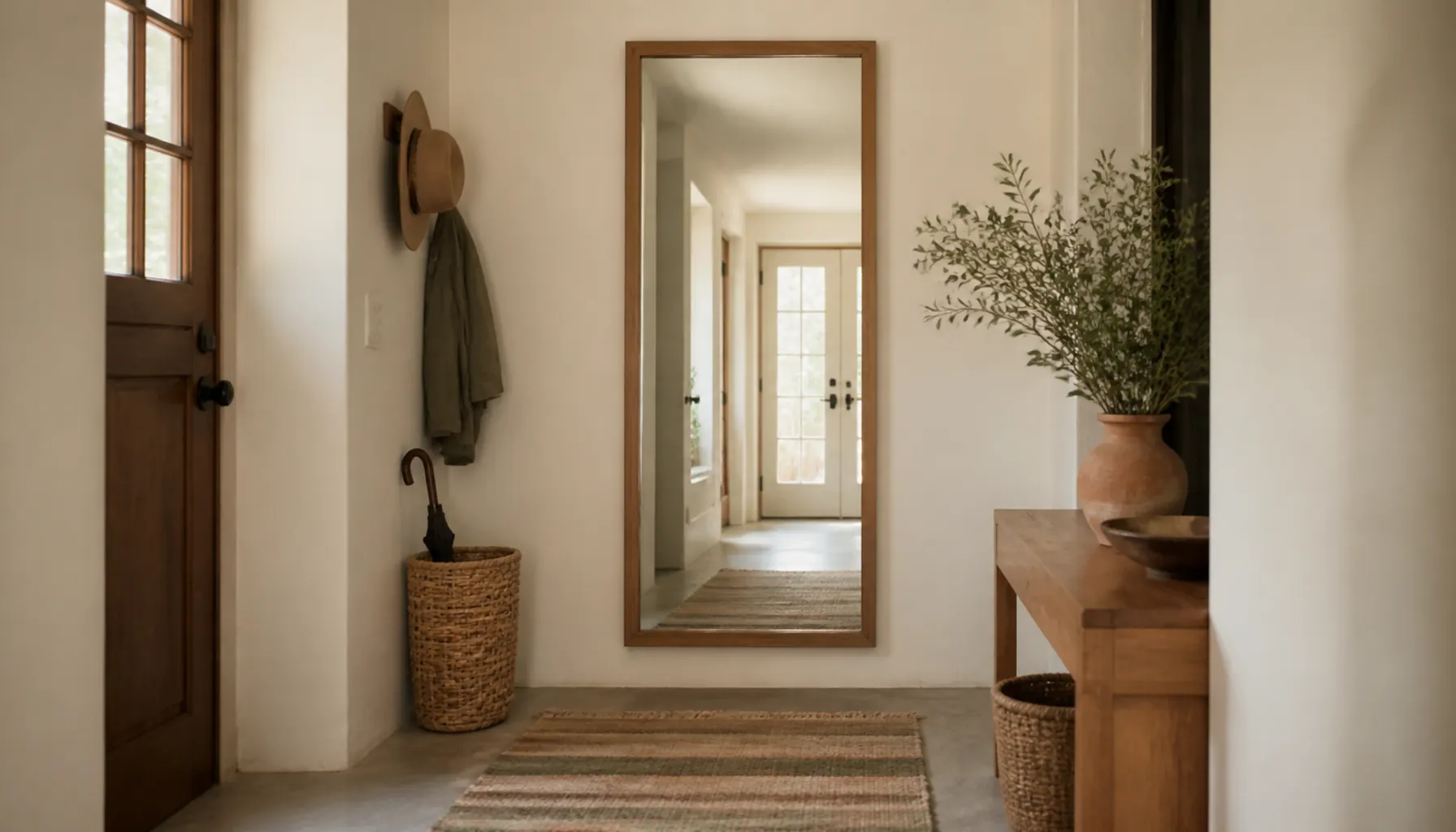
At a door, the frame material matters more than the shape. A wide oak or ash frame gives the hard surfaces around it something to relate to, and a rattan-wrapped frame does the same job with more surface texture. A thin painted MDF frame is the one that fails: its bottom edge sits where damp air collects, and once the paint film cracks the core swells.
Placement is a light decision, not a symmetry decision. Hang the mirror facing the daylight source or the main fixture, even if it sits off center on the wall, because a mirror opposite a dark wall reflects only the dark wall.
In a narrow entry a tall mirror beats a wide one, since it carries the eye up and lends a corridor some depth without taking floor.
Idea 6: Put Limewash or Clay Paint on the Upper Walls
Limewash and clay paints dry in soft, cloudy variations rather than one flat film, which is what a small space with one window needs. Flat latex in a dim entry reads as a single dead tone. The same color in a mineral finish shifts as you walk past it.
The trade is scrubbing. These finishes are porous and matte, so they mark, but touch-ups blend instead of leaving the visible rectangle you get patching flat latex. Keep them above the wear line and put something tougher below.
For color, lean warm: sand, clay, or a soft putty. Gray-cast whites go cold and slightly grubby where no direct sun reaches. If the entry opens onto other rooms, pick the tone as part of a wider scheme using these whole house paint palette ideas.
Idea 7: Use Tongue and Groove as the Wear Surface
Below hip height, an entry wall gets hit by bags, umbrella tips, shoe heels, and vacuum cleaners. Wood boards take that better than any paint finish. Run tongue and groove or beadboard up to about chair rail height, cap it with a narrow ledge, and the damage lands on something you can wipe or repaint in one panel.
Board direction changes the room. Vertical boards pull the eye up, which helps a low entry. Horizontal boards stretch a short wall sideways, useful when the entry is really just a corner.
Solid pine holds up best in the splash zone near the floor. Primed MDF boards are cheaper and fine higher up, but wrong where a wet umbrella gets propped.
Budget Alternative: Clear-finished pine boards below and paint above cost far less than full height oak paneling, and raw wood against a soft mineral finish is more interesting than one material running floor to ceiling.
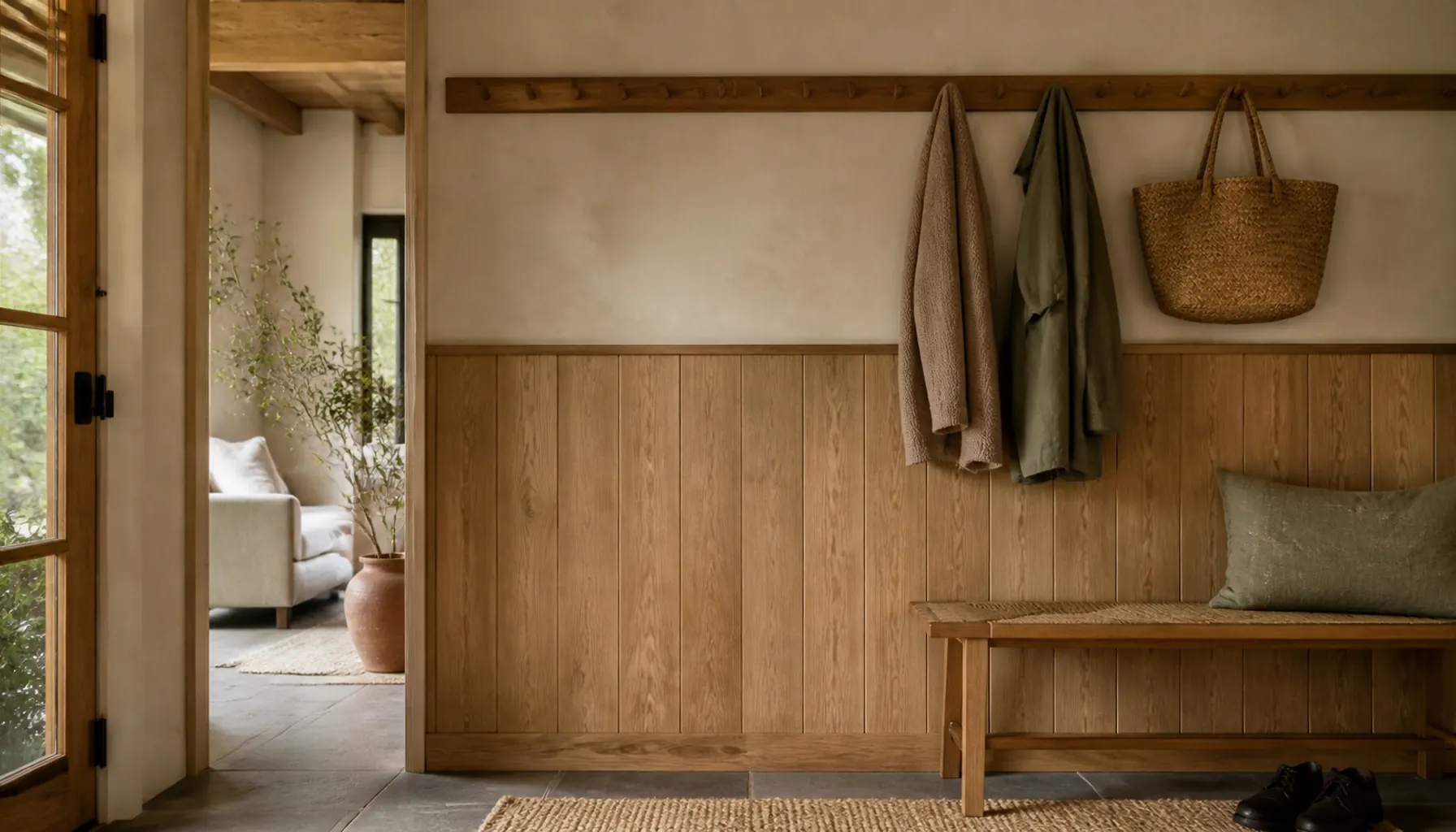
Idea 8: Store Shoes in Something That Breathes
Sealed shoe cabinets are the reason entries smell. Damp leather and canvas need airflow, and a closed box of coated particleboard traps moisture against the shoe.
Cane door fronts and open woven baskets solve it. A cane fronted cabinet keeps the clutter out of sight while still moving air, and a rattan or seagrass basket is the cheaper version of the same idea for boots and sports shoes.
One caution: woven fiber and standing water are a bad match. A dripping boot goes on the stone tray from Idea 1 until it stops shedding water, then into the basket. Woven storage also gives a hard tiled entry something soft to look at, a contrast covered in mixing textures.
Idea 9: Light the Materials From the Side
Texture disappears under a ceiling fixture pointing straight down. Limewash goes flat, wood grain reads as brown, and a woven basket loses its weave. Light crossing a surface at an angle is what makes those materials visible.
A wall sconce beside the mirror, a small plug-in lamp on a shelf, or a picture light over the peg rail all do this. Two low sources beat one bright overhead for arriving after dark, since you get enough light to see without a ceiling fitting glaring in your eyes.
Bulb warmth matters as much as position. A cool white bulb turns oak gray and pushes terracotta toward mud. Keep the entry bulbs the same warmth as the room you walk into next, or the transition looks like a fault. Those problems overlap with 5 lighting mistakes that make rooms feel cold.
Idea 10: Pick Greenery That Tolerates a Doorway
An entry is a hard place to keep a plant alive: cold drafts every time the door opens, temperature swings, and often almost no daylight.
Cut branches in a heavy stoneware jug are the most reliable option. Eucalyptus, willow, or bare winter stems last for weeks, need no light, and read as green without pretending to be a houseplant. Dried grasses work in the same vessel through winter. If the entry does get some daylight, a snake plant or a pothos will cope.
Placement is the part people get wrong. Anything at shoulder height in a traffic path gets knocked by a coat sleeve. Put the vessel on a shelf above the reach of bags, or on the floor in the dead corner behind the door swing. For arranging it, our indoor plant styling ideas go further.
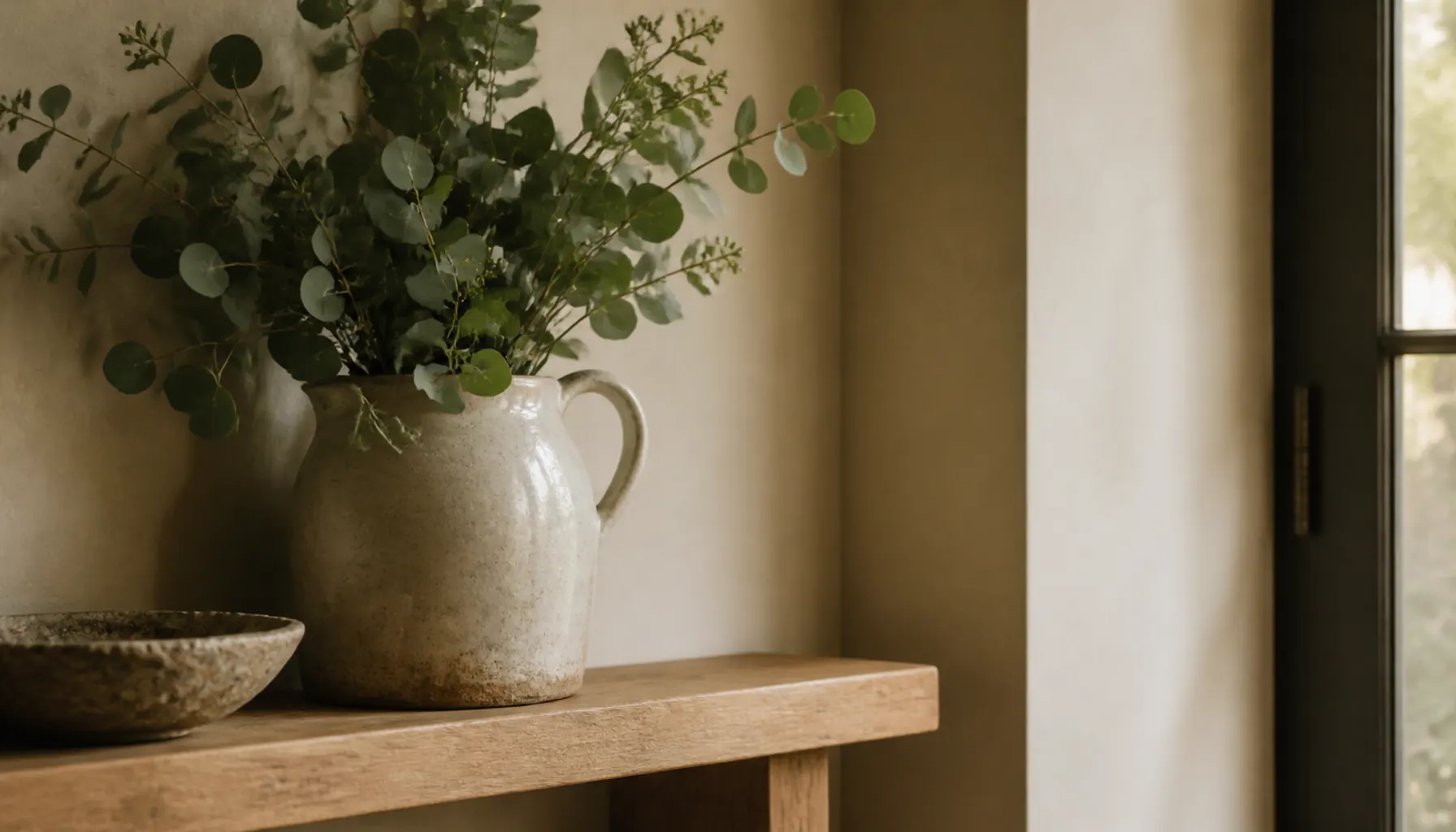
Idea 11: When the Door Opens Straight Into the Living Room
With no hallway, the entry has to be invented, and a material change is the cheapest way to invent it. A tile inset, a stone slab, or a hard mat with a defined edge marks where outside stops. Let a wool runner or the edge of the living room rug pick up from there, so the floor tells the story the architecture does not.
Vertical structure helps too. A slatted wood screen or an open backed shelf gives the door a wall to work against without blocking daylight, and its entry side can carry hooks. Options for that piece are compared in these wooden room divider ideas for open living rooms.
Align the sofa back or a low cabinet with the edge of the entry zone. Even an implied boundary stops the door area from creeping into the seating.
Idea 12: In a Narrow Entry, Go Up the Wall
Depth is what makes a corridor entry unusable, so measure the door swing and the walking width before anything else. Whatever remains is the depth budget, and it is usually smaller than a standard console.
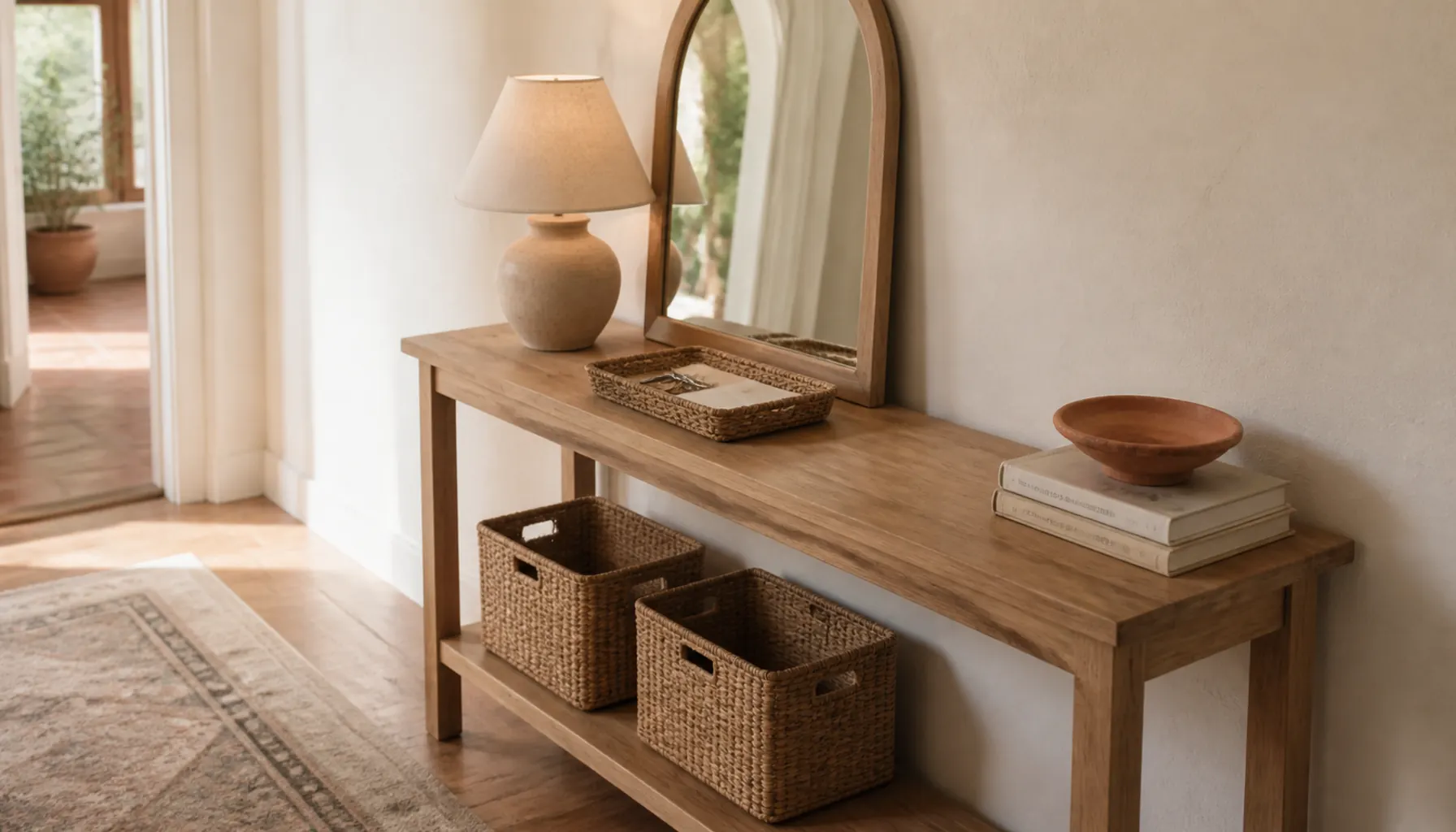
Move the materials onto the wall. A peg rail, a slim wall hung wood shelf, and a tall mirror take almost no floor, and our console table decor ideas cover styling a shelf that narrow without it filling up.
Skip the bench if the width will not take it and use a small wooden stool that tucks fully under the shelf. Baskets belong underneath rather than beside, since anything standing away from the wall makes the passage read as blocked. More ways to buy back inches are in these small apartment storage ideas.
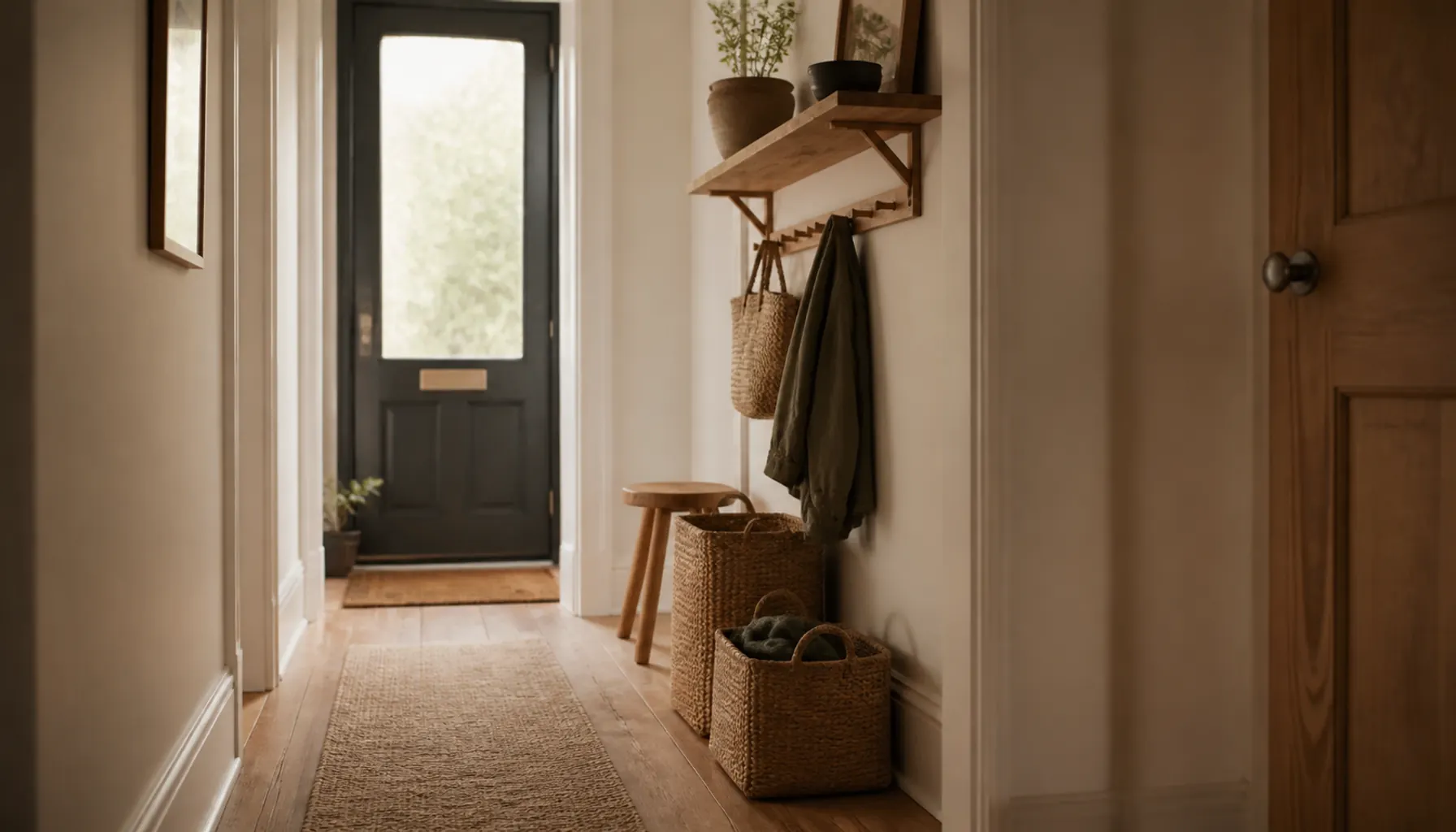
Expert Tips for Keeping It Looking Good
- Swap the fiber by season, not the whole scheme. A wool runner through winter and a washable cotton flatweave through the wet spring months keeps one layout working year round. Fold the change into the seasonal home reset checklist so it happens on a date rather than once the runner looks bad.
- Repeat one wood tone at three heights. The bench, the peg rail, and the mirror frame in the same species tie a small space together faster than any color decision.
- Use metal sparingly. Brass reads as jewelry in an entry. Hooks and one light fitting are enough; past that it looks like hardware.
- Re-oil the wood once or twice a year. Ten minutes on the bench and any exposed shelf edges keeps water out of the grain.
Frequently Asked Questions
Which natural material holds up best in an entryway?
Stone and sealed tile, for the floor where shoes land. They shed water and salt, wipe clean, and do not stain. For the softer part of the entry, wool is the most durable fiber, since it springs back under traffic and hides light soil. Solid hardwood is best for benches and shelves, because it can be sanded and re-oiled when it marks.
Is a jute rug a bad idea in an entryway?
In a wet entry, yes. Jute absorbs water, darkens where it gets damp, stiffens with salt, and cannot be wet cleaned without leaving marks. In a dry entry, behind a covered porch or in a mild climate, a jute runner works and feels good underfoot. Either way, keep it out of the first few feet where boots drip.
How do I keep natural materials from looking mismatched?
Limit the count. Two wood tones, one stone or tile, one natural fiber, and one metal is plenty for a space this small, and each should appear at least twice. Repetition is what makes a mix read as a scheme rather than an accumulation of separate purchases.
Can I do this in a rental?
Most of it. A peg rail needs a few screws and patches easily, a stone boot tray needs none, and a runner, a leaned mirror, a woven basket, and a plug-in sconce leave nothing behind. Wall treatments are the part that usually needs permission, though a removable slatted panel screwed to a batten is a middle option.
How do I stop a wood bench getting ruined by wet shoes?
Keep the wet part off it. Shoes go on the stone tray or the hard threshold, not the bench base. Choose an oil or hardwax finish so a mark can be spot repaired instead of refinishing the whole piece, wipe road salt off the same day it appears, and re-oil the feet and lower edges, where water sits longest.
Where to Start
Work from the floor up. Sort the wet zone first, with a stone tray or hard mat and a coir scraper, because nothing else survives if grit and water still travel through it. Then put the hooks up, since coats on the floor undo every other improvement. The runner comes third, once you know where the dry zone begins.
Wall treatments come last. They are the most satisfying change and the least urgent, and by then you will know where the bags actually hit the wall and how high the boards need to run.
One useful home email a month
Real ideas to make your home work better. No spam, easy unsubscribe.