12 Indoor Plant Styling Ideas: Where to Put Plants
Twelve indoor plant styling ideas about placement: where to put plants for height, light and scale, which spots get overlooked, and how many one room can take.

· 13 min read
Most plant advice starts with the plant. Placement works better in reverse: look at the spot first, work out what light it gets and what it sits beside, then choose something that can live there. That one switch fixes the two problems people actually have, which are plants that slowly fade in a dark corner and healthy plants that look randomly parked.
The twelve ideas below are all about position. Where a plant goes, how high it sits, what it stands in, which surfaces get skipped, and how many a room can take before greenery stops reading as styling and starts reading as a nursery. Almost none of it needs a shopping trip. Most of it you can do this afternoon by moving what you already own.
Key Takeaways
- Choose the spot before the plant. Matching a plant to real light beats moving a struggling one around later.
- Three heights beat three plants at the same height. Floor, table, and something high or trailing gives the eye a path.
- Group in odd numbers and vary leaf shape, not just pot size, or the cluster looks like a set.
- One pot material family does more for cohesion than matching the plants themselves.
- Scale to the furniture beside it. A small plant next to a full-height bookcase reads as an accessory, not a feature.
- A room usually needs fewer plants than you think. Aim for one clear green moment per sightline.
12 Indoor Plant Styling Ideas Worth Trying
Idea 1: Read the Light Before You Pick the Plant
Stand in the spot you want to fill at mid-afternoon and look at the shadows. Crisp, hard-edged shadows mean direct sun. Soft, blurry ones mean bright indirect light. No real shadow at all means low light, whatever the room feels like to you. Eyes adjust to dimness in seconds, which is why a corner that seems fine to you can be genuinely dark for a plant.
Do that read first and the rest gets easy. Direct sun near a window suits sun lovers. Soft light a few feet back suits most common houseplants. For a corner with no shadow, either accept slow decline or use faux greenery that actually looks real and keep the live plants where they can earn their keep.
Idea 2: Spread Greenery Across Three Heights
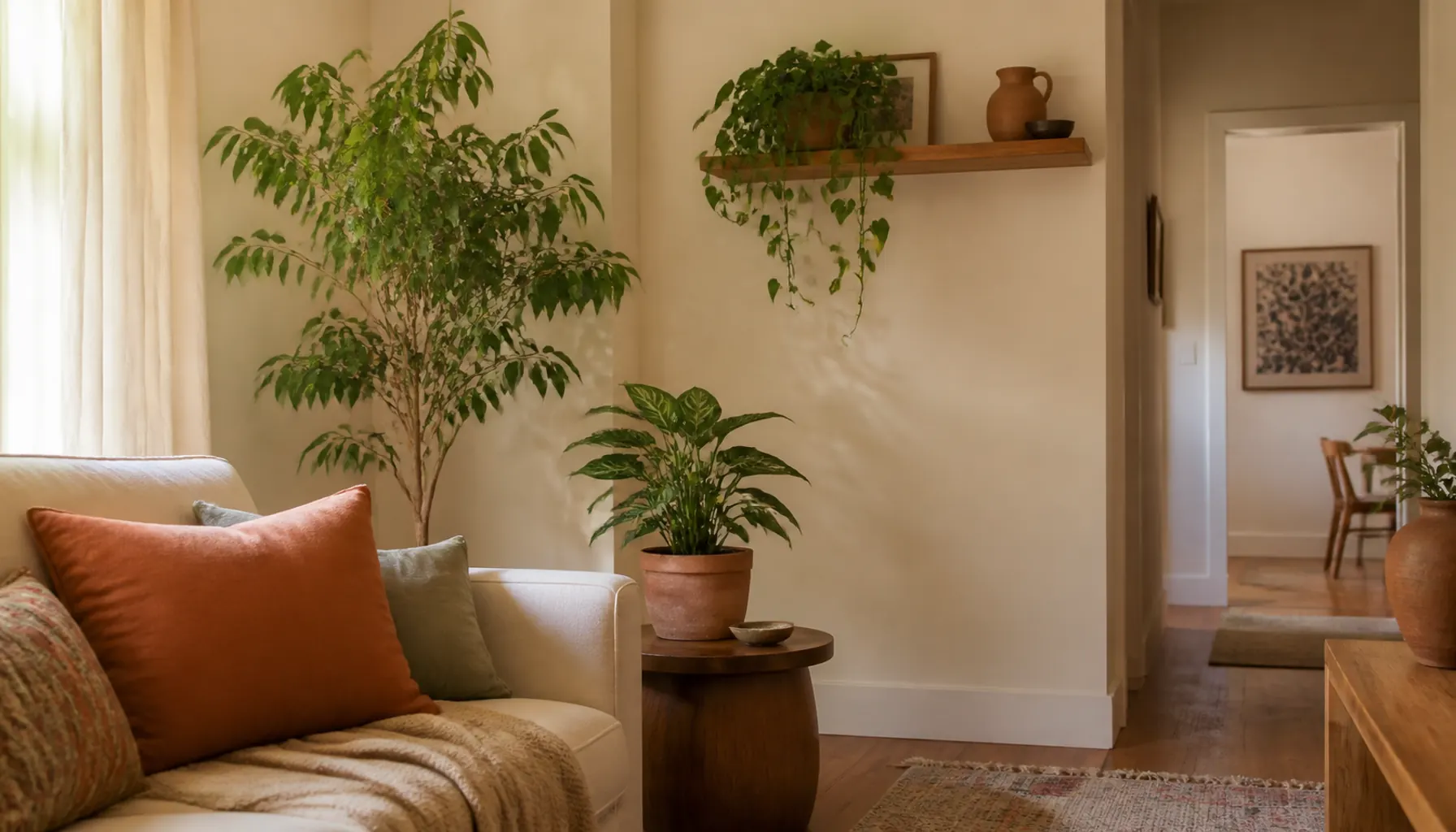
A room reads as planted, rather than decorated with plants, when greenery appears at three levels: floor, roughly table or eye level, and high or trailing. Your eye travels the wall instead of stopping at one point.
Work out the levels you already have. A tall floor plant beside a sofa arm covers low. A small pot on a side table or shelf covers the middle. The high level is the one most people skip: the top of a wardrobe, a bracket above a window, or a bookcase's upper shelf. Fill that and the room stops feeling bottom-heavy.
Keep the three at different depths in the room too, not lined up on one wall. Depth is what makes the grouping look grown rather than arranged.
Idea 3: Group in Odd Numbers With Different Leaf Shapes
Three pots together look intentional. Two look like a pair you were forced into, and four tends to read as a row. The reason odd numbers work is that your eye cannot split them evenly, so it groups them as one object instead of counting.
Numbers alone are not enough though. Vary the leaf shape as well: something upright and bladed, something broad and round, something loose that spills over the rim. Three round-leaved plants in three sizes still read as a set. Contrast is what makes a cluster look collected.
Vary the pot heights by a few inches too, and pull one slightly forward so the group has some depth. The same logic that keeps open shelves from looking cluttered applies here: one tall anchor, one mid, one low.
Idea 4: Give a Dead Corner One Big Plant, Not Three Small Ones
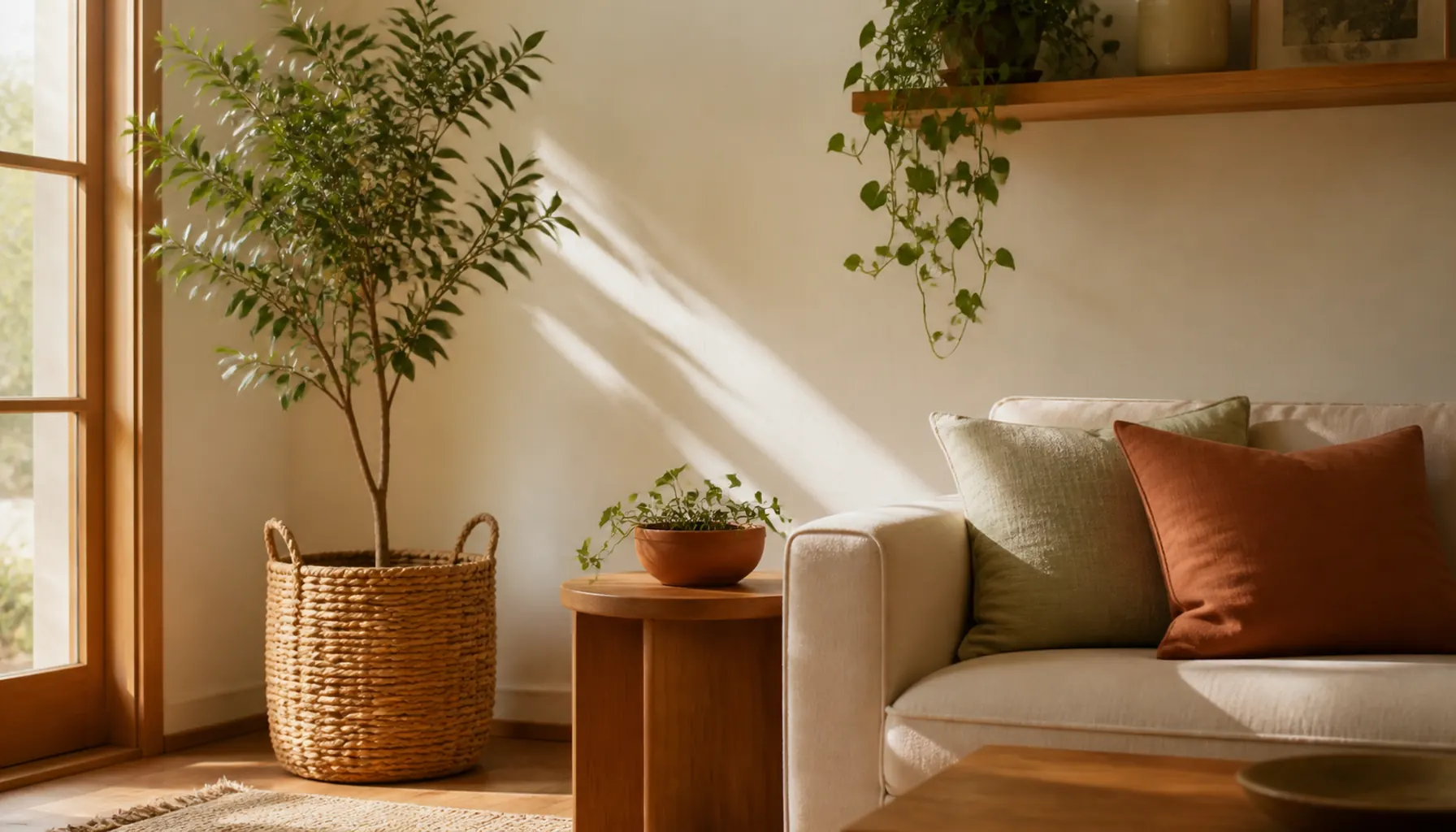
An empty corner is the most useful spot in the room and the one most often filled badly. Three small pots on the floor look like storage. One plant tall enough to relate to the furniture beside it looks deliberate.
The rough test: the plant should read at least as tall as the sofa back or the chair it sits next to, ideally reaching toward the lower third of the nearest wall art or window. Below that, it disappears. Buy the biggest one the corner can hold rather than several you will keep rearranging.
Give it clear floor around the base, and let the pot sit on the rug rather than half-on and half-off, which looks accidental. Our notes on choosing and sizing a rug cover how those edges affect the whole corner.
Idea 5: Keep the Pots in One Material Family
Mixed plants look calm when the containers agree. Pick one material family and repeat it: unglazed terracotta, cream stoneware, or woven baskets in natural fiber. Within that family, vary the size and shape freely.
The reason this works better than matching plants is that pots are what you actually see at pot height, in a solid block of color. Ten different finishes read as noise even when every plant is healthy. Terracotta suits warm rooms and deepens as it ages, which sits naturally in the palette from our guide to terracotta and neutral styling. Cream ceramic is quieter and works in cooler, grayer rooms.
Mix matte and glossy within one color rather than across several. That gives you surface variety without breaking the family, the same principle behind mixing textures without clashing.
Renter Tip: For the high level, a tension rod across a window recess or a leaning ladder shelf gives you hanging height with no holes. Both hold a light trailing plant fine, and both come down in a minute.
Idea 6: Use a Plant Stand to Fill the Knee-Height Gap
There is a dead zone in most rooms between about knee and hip height, usually beside a sofa arm, under a window, or in the gap next to a cabinet. It is too low for a shelf and too high for a floor pot. A plant stand is the cheapest way to fill it.
A stand does two jobs. It lifts a mid-size plant into that gap, and it raises trailing foliage high enough to actually hang instead of pooling on the floor. A slim three-legged stand takes almost no visual space, so the plant reads as floating.
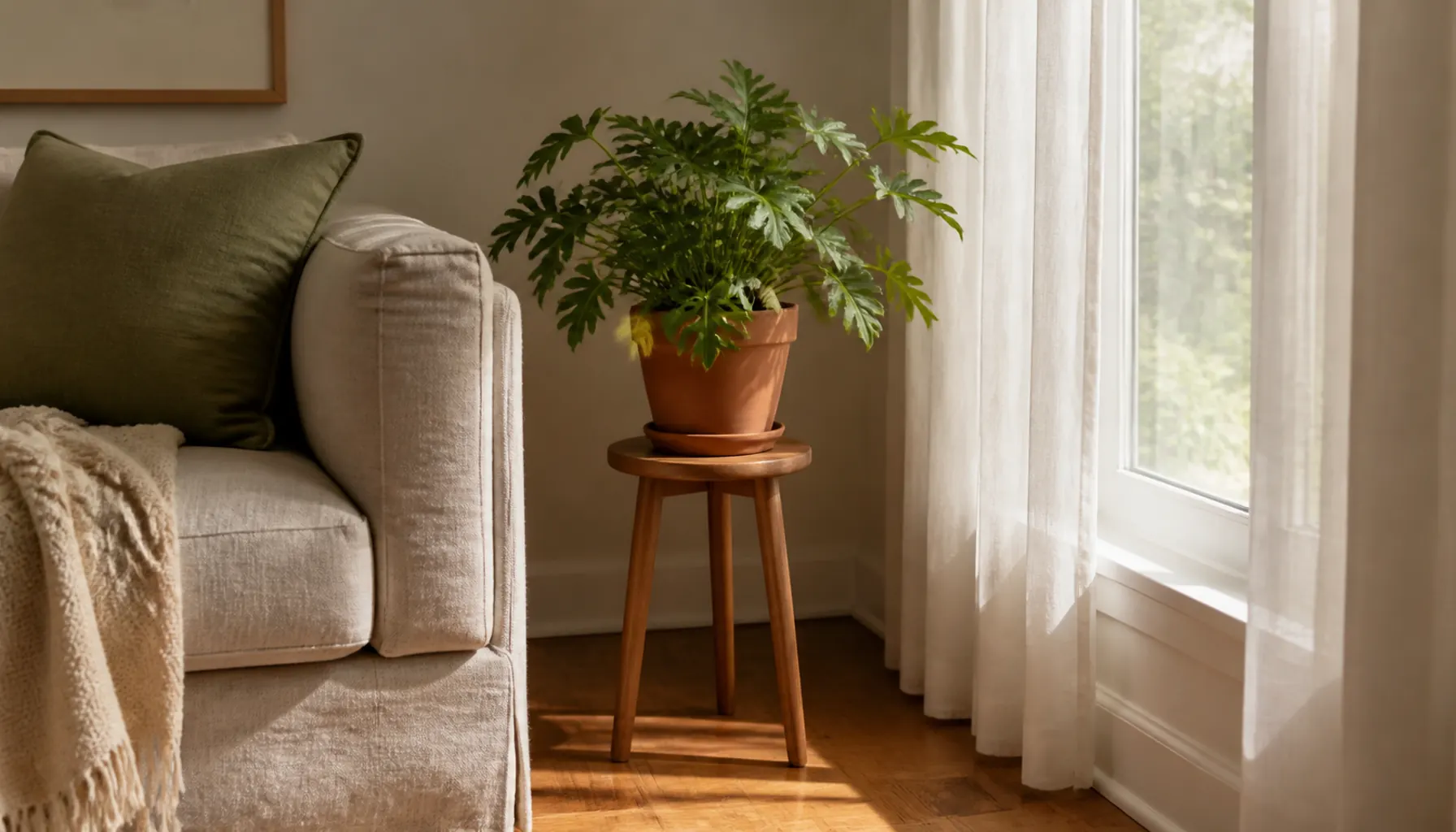
Watch the sightline from where you sit. If the plant now blocks the view across the room or the reading light, move the stand a foot to one side rather than swapping the plant.
Idea 7: Put a Trailing Plant Where Two Hard Edges Meet
Look for the sharp corners in your room: the top edge of a tall bookcase, the square end of a kitchen cabinet run, the point where a stair rail meets the wall, the boxy top of a fridge. Those hard angles are what make a room feel unfinished even when it is fully furnished.
A single trailing plant set slightly back from that edge breaks the line without hiding it. The foliage crosses the corner at an angle, so the eye reads a soft interruption instead of a right angle. This is one of the few cases where the plant is doing structural work rather than decorative work.
Keep the pot small and the trail long. A big pot perched on a high edge looks precarious and draws attention to the very corner you were trying to soften.
Idea 8: Style a Mantel With One Plant, Off Center
Mantels tempt people into pairs, one plant at each end. Skip that. A fireplace is already a strong symmetrical focal point, so matching plants just add weight to both sides and flatten it.
Instead, put one plant near one end, roughly a third of the way in, and let it trail down over the edge. Balance it with something low and horizontal at the other end: a stack of books, a shallow bowl, a leaning frame. The plant becomes the tall element and the whole arrangement gets a diagonal.
Heat matters here. If you light the fire, the mantel gets hot air rising across it, so move the plant off before you do and keep a hardy one there rather than something delicate. The same asymmetry helps the wall above, which our take on gallery walls gets into.
Idea 9: Fill the Gap Above the Kitchen Cabinets
The strip between upper cabinets and the ceiling is one of the last places people think to style, and it is usually right beside a window. Trailing greenery up there does something specific: it draws the eye up, so the cabinets read as part of the wall rather than as a heavy box.
Two or three pots, spaced unevenly and pushed slightly apart, work better than a continuous line of them. Keep the same pot material as the rest of the kitchen so it looks planned. Reach is the real constraint, so pick something that tolerates a missed watering and choose a lightweight pot you can lift down with one hand.
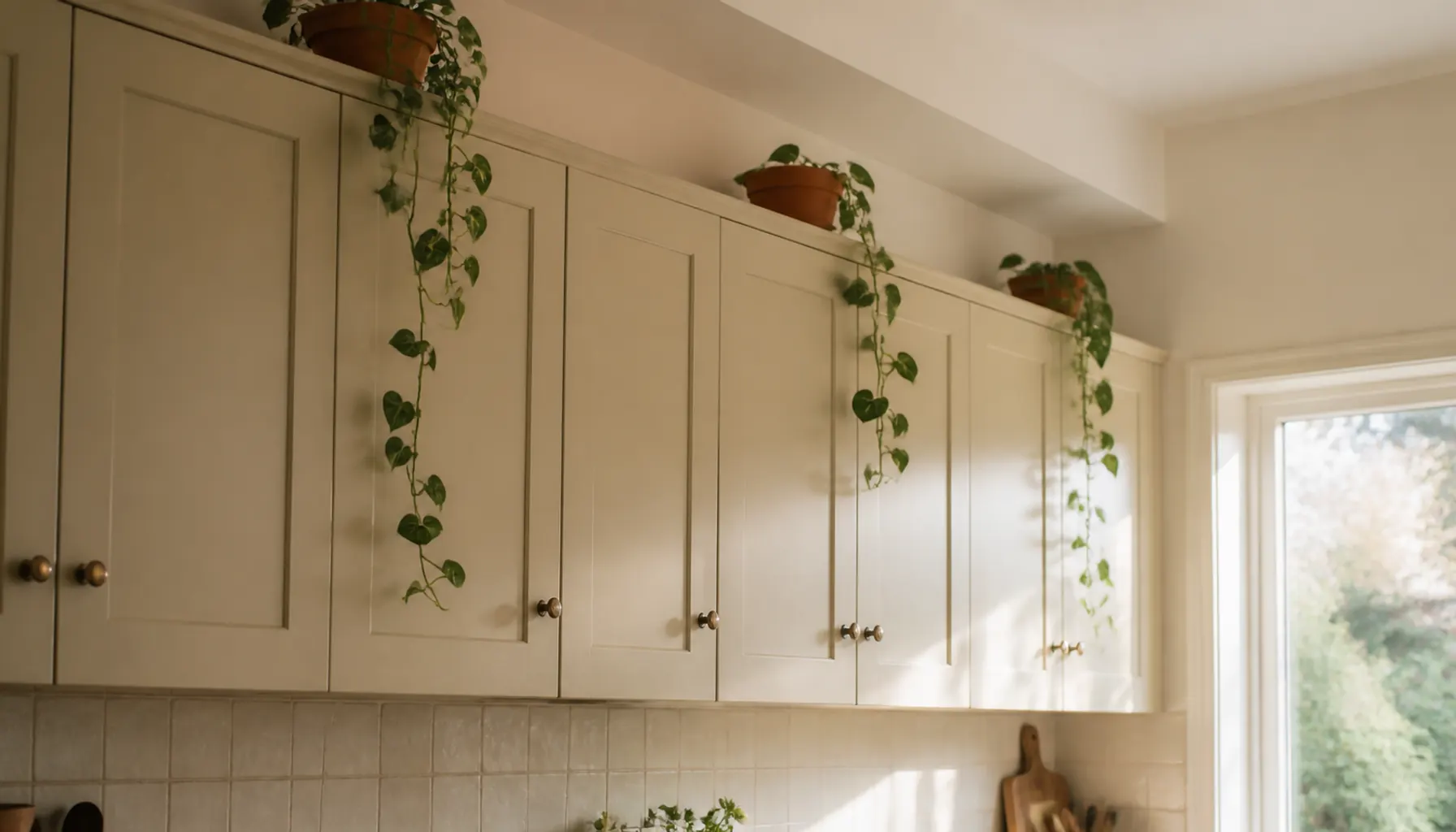
Avoid the spot directly above the range, where grease and heat both collect. If your kitchen is set up around zones for how you actually cook, put the greenery over the quiet zone, not the working one.
Idea 10: Treat the Bathroom as a Real Placement Opportunity
Bathrooms get overlooked because people assume there is nowhere to put anything. Look again: the corner of the vanity, the ledge behind the taps, the shelf above the toilet, a hook beside the window, the corner of the bath surround.
The humidity genuinely helps many houseplants, so a bathroom with any real window is a good home rather than a compromise. Small pots suit these spots better than anything statement-sized, because every surface here competes with things you use daily. One plant on the highest available surface usually reads best, since it stays clear of splashes and clutter.
Windowless bathrooms are the honest exception. Nothing lives long in a room lit only by a ceiling fixture. That is faux territory. For the surfaces themselves, bathroom organization for small shared spaces covers what to clear first.
Idea 11: Turn Each Plant a Quarter Every Time You Water
Plants lean toward light. Leave one still for a few months and it grows lopsided, with a full side facing the window and a thin side facing the room. That thin side is the one you look at.
Turning each pot a quarter turn whenever you water keeps growth even, and it takes seconds. It also means the plant you styled facing a certain way keeps looking that way, instead of slowly turning its back on the room.
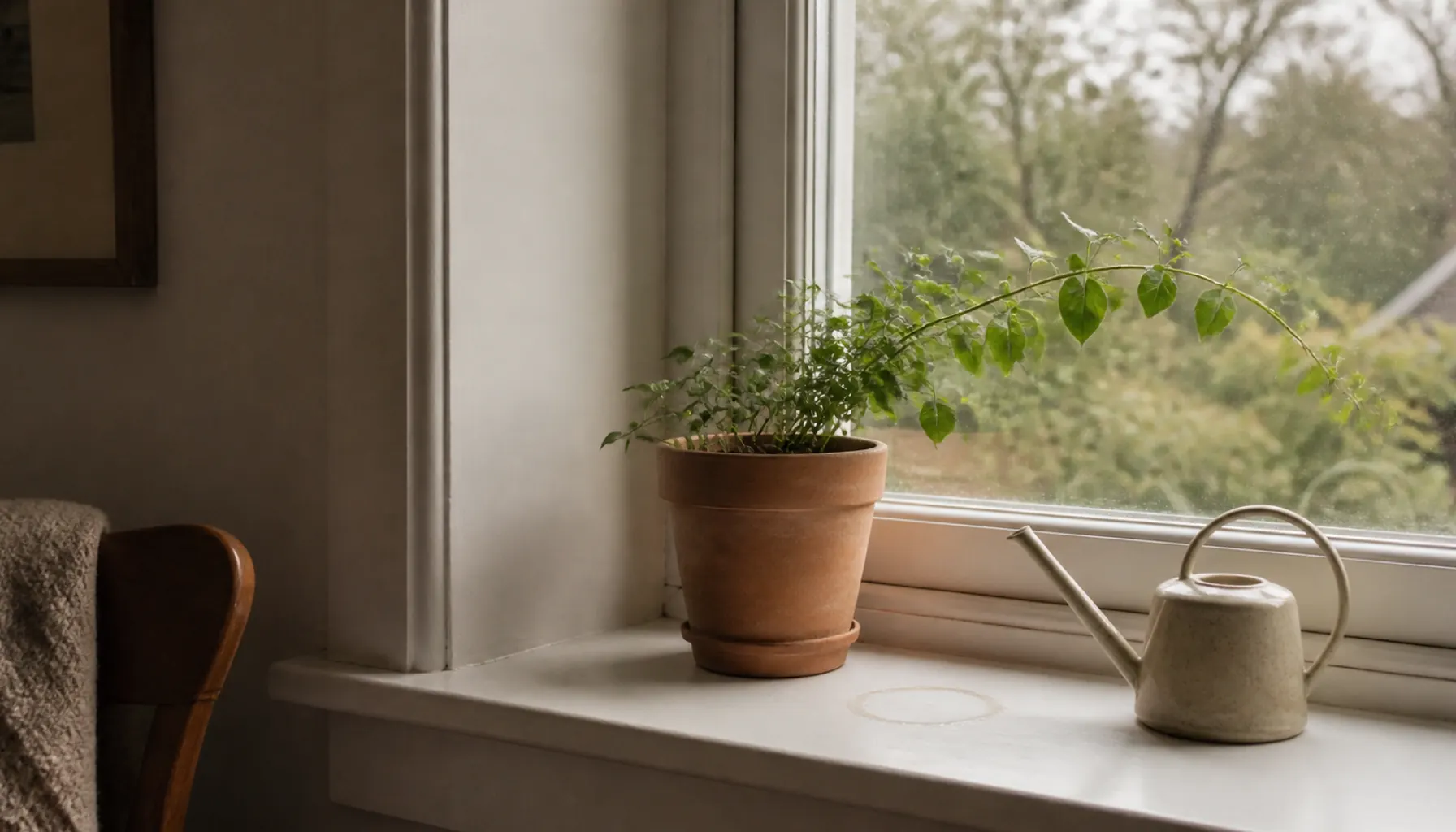
Worth also reconsidering placement as the seasons shift. A spot that was bright in summer can go dim in winter, and a plant that scorched near a south window in July may be fine there in January. If a plant is unhappy, moving it is usually the first fix, not the last.
Idea 12: Decide How Many the Room Can Take
More plants is not the goal. Restraint is what separates a styled room from a collection, and the useful rule is one clear green moment per sightline. Stand in the doorway: you should be able to name where the plants are without scanning.
Signs you have gone past the line are easy to spot. Surfaces you can no longer put a cup down on. Pots on the floor you step around. A shelf where the plants have crowded out everything else. At that point, greenery has stopped being an accent and become the room's main texture, which also makes watering a chore rather than a two-minute round.
Fewer, better-placed plants also give each one clear space around it, which is exactly what makes a small bedroom feel calm rather than full.
Common Placement Mistakes
- Putting a plant on top of a radiator or under a vent. Dry moving air is harder on foliage than low light, and the spot looks like a shelf of convenience.
- Lining pots up along a windowsill in a neat row. Even spacing reads as inventory. Cluster two and leave a gap.
- Choosing a plant for the pot you already own. The pot is the easy thing to change.
- Filling every corner. Leaving one corner empty makes the planted ones look chosen.
- Blocking the light you actually use. A tall plant in front of the only window costs you more than it gives.
Frequently Asked Questions
Where should you put plants in a living room?
Start with the corners and the gaps beside furniture, then work upward. One tall plant in a dead corner, one mid-height pot on a side table or stand, and one trailing plant somewhere high covers the room without crowding it. Keep them at different depths rather than along one wall, and leave the spot in front of your main window clear.
How many plants should be in one room?
Fewer than most photos suggest. A useful measure is one clear green moment per sightline, so a normal living room usually sits at three to five placements rather than three to five plants per surface. If you are stepping around pots or cannot set a cup down, the room has passed the point where greenery reads as styling.
Do plants have to match to look good together?
No, and matching plants is usually the weaker approach. Cohesion comes from the pots, not the foliage. Repeat one container material in varied sizes and you can mix wildly different plants freely. Contrasting leaf shapes within a group actually helps, because identical shapes in three sizes look like a bought set.
What can I do with a corner that gets no natural light?
Accept that live plants will decline there and choose accordingly. A good faux plant styled in a real pot with a soil topper works in that spot for years, and it frees you to put the live plants where the light is. If you want something real, dried stems in a tall vase need no light at all and hold up indefinitely.
Should plants go on the floor or up on something?
Both, ideally in the same room. Floor pots need enough height to relate to nearby furniture, so anything shorter than about sofa-back height looks lost down there and does better lifted. Plant stands, shelves, and cabinet tops earn their place by filling the knee-to-hip gap and by giving trailing plants somewhere to actually trail from.
Where to Start
Pick the emptiest corner in the room you use most, check the shadow there mid-afternoon, and put one plant in it that is tall enough to hold its own against the furniture beside it. That single placement usually does more than five small pots scattered across a room.
From there, add the middle height, then the high one, and keep the pots in one material family as you go. If the room's lighting still feels flat once the greenery is in, the fixes in these lighting mistakes will do more for the corner than another plant will.