12 Record and Music Wall Art Ideas for a Gallery Wall
Frame album sleeves, rotate covers on a ledge, light glossy art without glare, and hang instruments safely. 12 record wall art ideas that keep vinyl playable.

· 14 min read
Album sleeves are already art. They are already square, already the same size as each other, and most of them are already in your living room. That makes record wall art one of the few gallery wall projects where you start with a matched set instead of a pile of mismatched frames. The catch is that music on a wall goes wrong in two specific directions: it either looks like a shop display, or it quietly ruins the records. This is a guide to the display decisions: the frames actually made for 12 inch covers, lighting that does not bounce off a glossy sleeve, and which copies belong on the wall rather than in the crate.
Key Takeaways
- Measure a sleeve before buying frames. Album covers run a little over 12 inches square, so frames sold in standard print sizes leave awkward gaps.
- A picture ledge beats a wall of frames if you plan to rotate. One mount, and the display changes in seconds.
- Keep sleeves under half the wall. A grid of nothing but squares reads as merchandising, not decorating.
- Display copies and playing copies should be different records. Sun fades sleeves and heat warps vinyl.
- Glare is the real enemy. Glossy card behind glass reflects twice, so light it from a steep angle or use matte glazing.
- Instruments need a proper hanger and a stable wall, away from direct sun, radiators, and damp exterior walls.
- One wall of music is plenty. The restraint is what makes the collection read as taste rather than inventory.
12 Record and Music Wall Art Ideas Worth Trying
Idea 1: Frame Sleeves in Frames Built for 12 Inch Covers
Pull one sleeve out and measure it before you buy anything. Covers sit slightly larger than 12 inches square, which is why a frame sold for a 12 by 12 print squeezes the edges and a 12 by 16 leaves a strange border. Frames sold for records solve the fit. A sealed back-loading frame is cheaper and fine for art you will never change; a front-loading frame with a hinged face costs more and lets you swap the sleeve without lifting anything off the wall.
Go with acrylic glazing once you are hanging four or more: glass gets heavy fast in a group. Black frames give cream walls a crisp edge; walnut softens the same wall.
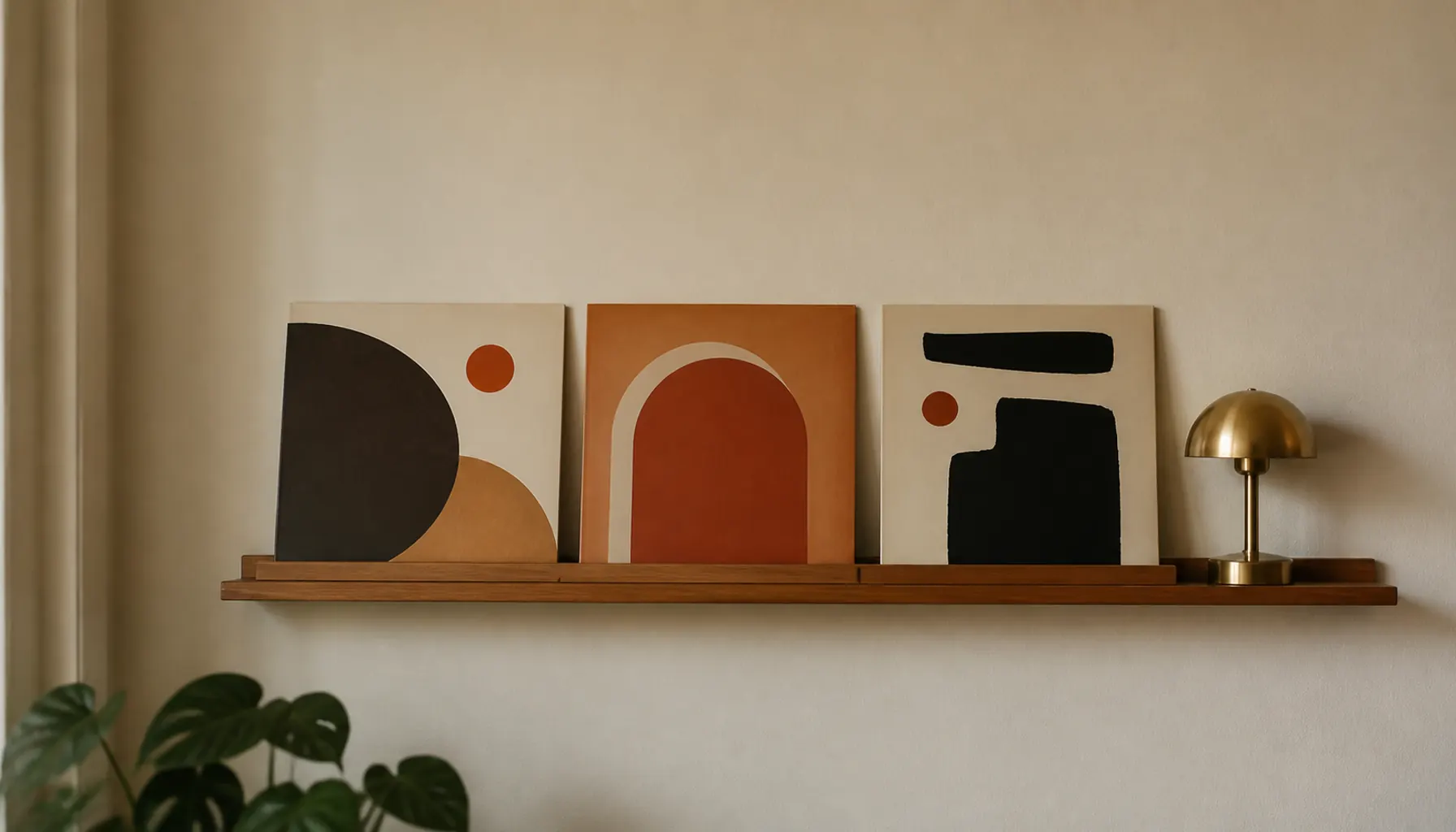
Idea 2: Lean Sleeves on a Picture Ledge Instead of Hanging Them
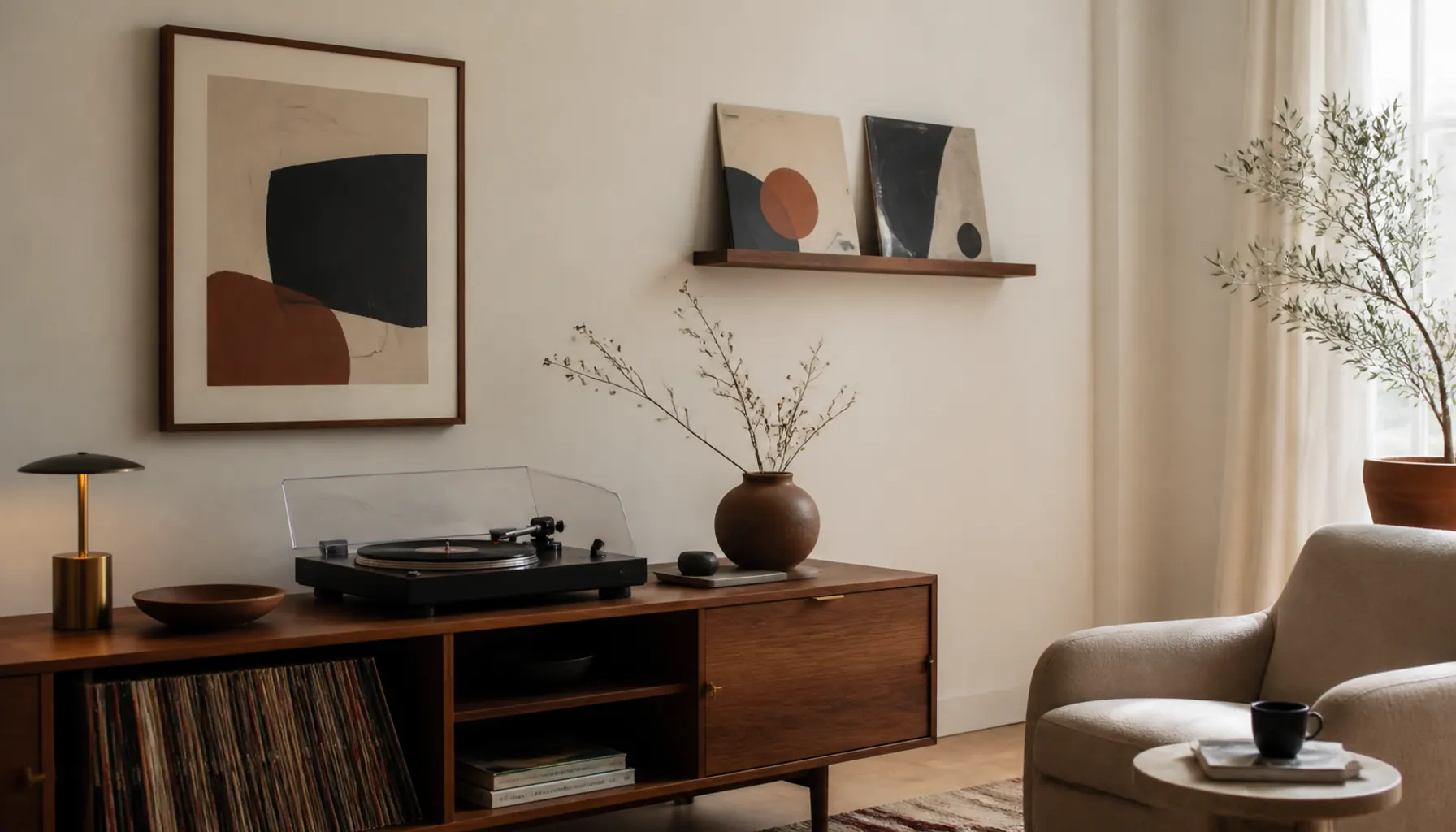
A narrow ledge is the best answer if you want the wall to change. You mount once, then rearrange as often as you like, which suits renters and anyone still deciding. Keep the ledge shallow, deep enough for a sleeve to lean at a slight angle and no deeper, or it turns into a shelf for keys and mail.
Two ledges stacked look deliberate if the vertical gap gives each sleeve a little air above it. Lean covers two or three deep and treat the front one as the piece on show. For the mounting itself, the damage-free hanging formula covers weight and adhesive limits, which matter more for a loaded ledge than for a single frame.
Idea 3: Hang One Record Above the Turntable and Change It Often
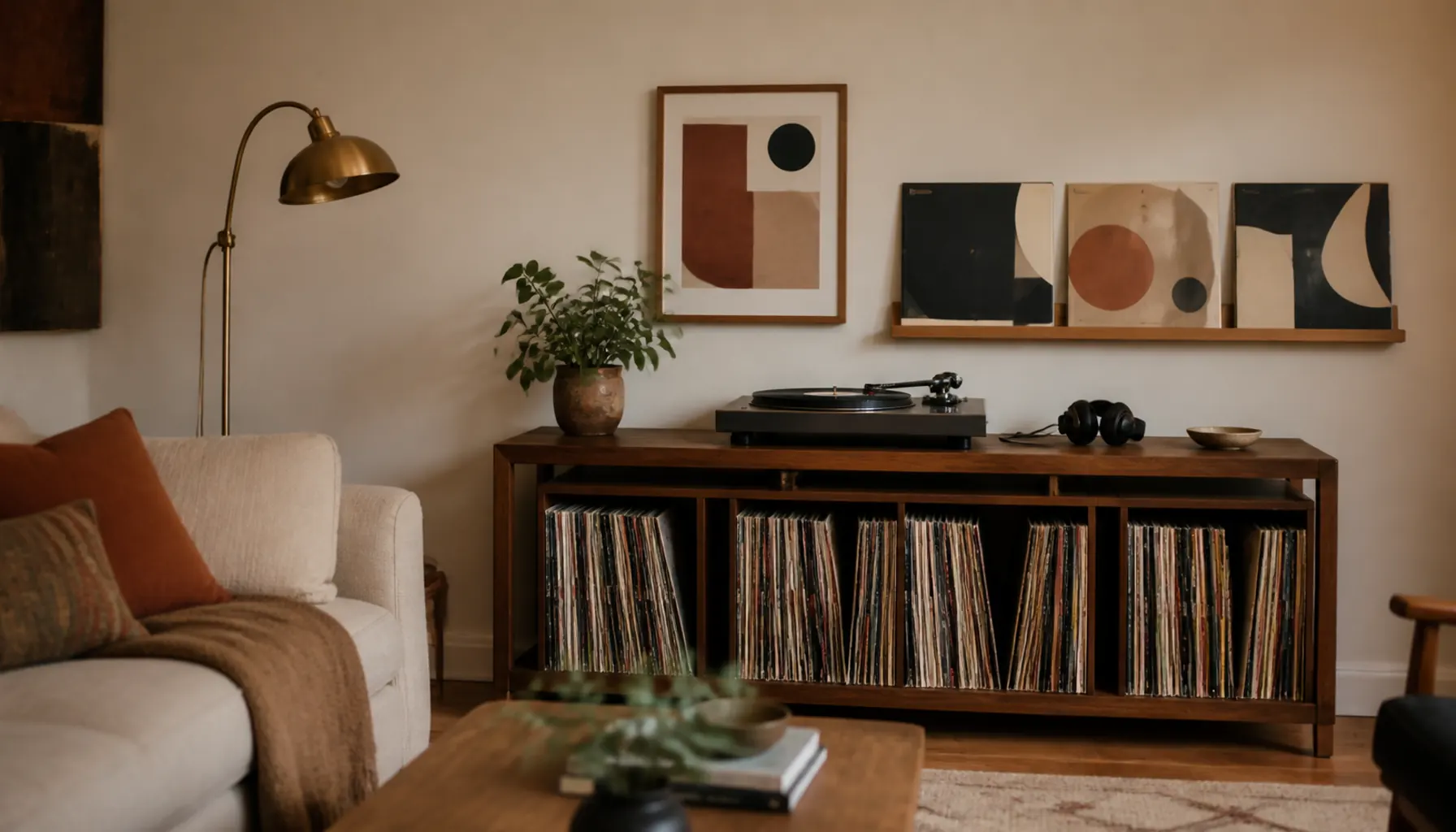
The strongest version of this look is not a wall of covers. It is a single framed sleeve hung above the deck, slightly off center from the turntable itself, low enough that the frame and the console read as one group rather than two separate things. Hang it high and the connection disappears.
Leave real clearance for the dust cover to hinge all the way open, or the frame gets bumped every time you play something. Then use the frame: put up whatever is on the platter this week. It becomes a habit rather than static decor. The rest of that surface benefits from the same editing logic as any other console table styling.
Idea 4: Break the Squares Up With Art That Is Not Music
Uniform squares in a straight row is what a record store wall looks like, and the fastest way to make a home feel like retail. The fix is proportion. Keep sleeves to somewhere under half the pieces on the wall and let the rest be a landscape print, a small mirror, a framed textile, or a photograph.
Shape matters as much as subject. One tall vertical frame or a round mirror interrupts a field of squares and gives the eye somewhere to break. Tie the group together with color instead: pull a rust or olive out of one sleeve and repeat it in a non-music piece nearby. If the arrangement itself feels stuck, work through the gallery wall planning method before you commit to spacing.
Idea 5: Hang an Instrument as an Object, With Real Caution
A guitar or a violin on the wall gives you a curved, handmade shape among all those flat squares, and the contrast between lacquered wood and matte plaster does a lot of work in a plain room. Use a hanger made for that instrument, with a padded yoke, and fix it into wall framing rather than trusting drywall alone.
Then be honest about the conditions. Wood instruments dislike dry air, heat, and swings between the two, so above a radiator, on a cold damp exterior wall, or in afternoon sun are all bad spots. If the instrument still gets played, keep it in a case. A thrifted piece past repair makes a better wall object anyway.
Idea 6: Give a Cheap Concert Poster an Expensive Backing
Rolled paper looks cheap for two reasons: it has a curl and creases from the tube, and it usually sits behind glass with no margin. Both are fixable. Flatten the poster under books for a few days on a clean flat surface, and give it as long as it needs.
Then buy the mat rather than the frame. A generous mat border, wider than instinct suggests, makes thin paper read as a considered print instead of a leftover. Cream or warm white mats sit better with sand and terracotta walls than bright optical white does. Keep the frame itself narrow and matte so the mat carries the visual weight. Do not dry-mount anything you would be upset to lose; use acid-free backing and corner mounts instead.
Idea 7: Grid Sheet Music and Small Ephemera Tightly
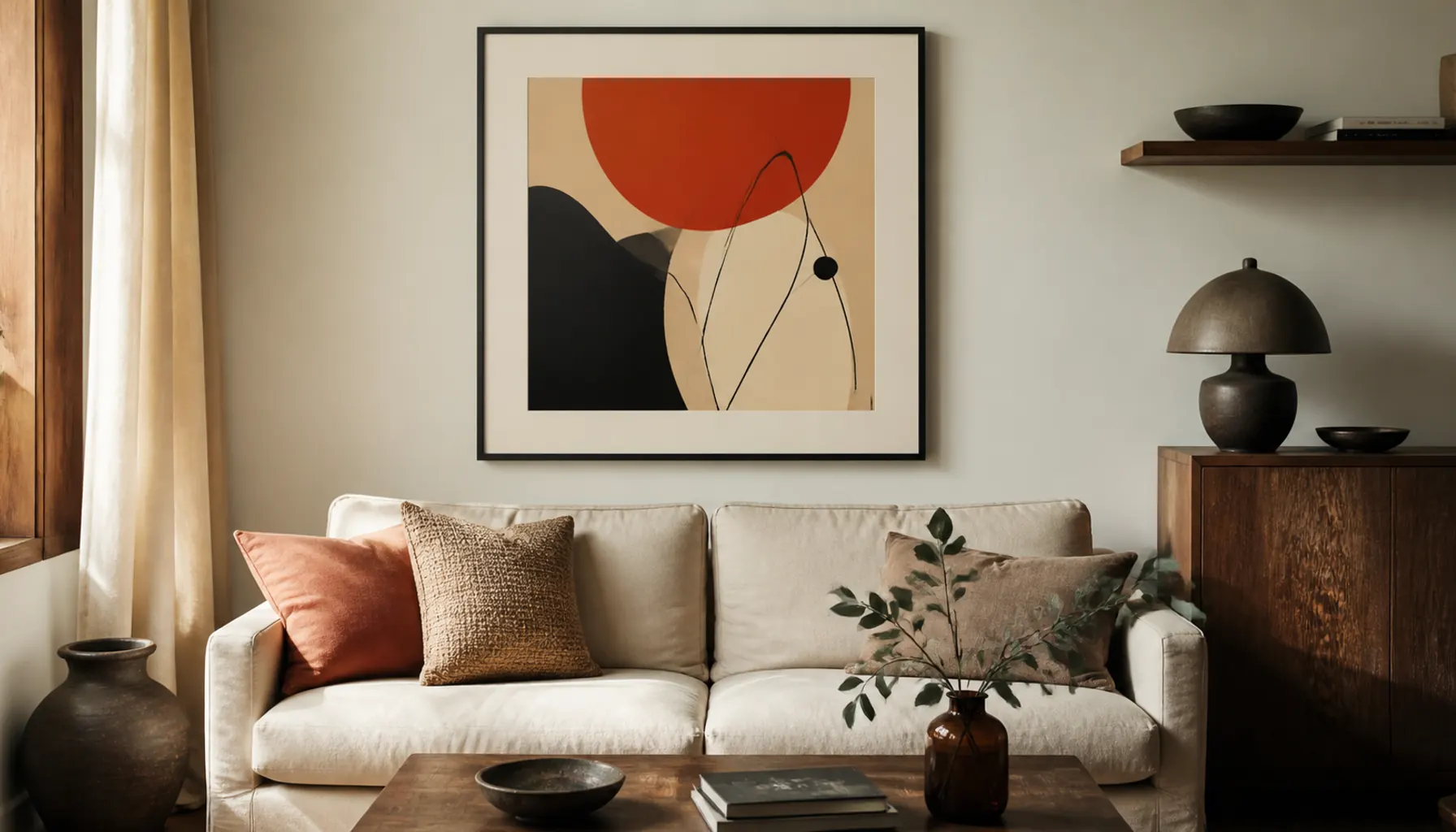
Small paper only works in numbers. Sheet music, ticket stubs, setlists, and postcards are too slight to hold a wall alone, so gather six or nine of them in identical small frames with identical mats and hang them as one tight block. Narrow, consistent gaps make the group read as a single rectangle, which is what gives it enough presence to sit beside a large sleeve.
Keep frames plain and matched: with this many pieces, any variation becomes the thing you notice. Old sheet music is often brittle and acidic, so if a page matters to you, frame a good scan and keep the original flat in a drawer. Nobody looking at the wall will know the difference.
Idea 8: Choose Between One Oversized Piece and a Dense Cluster
Wall width and viewing distance make this decision for you. On a narrow stretch, a chimney breast, or a hallway you walk past rather than sit in, one oversized piece wins. A large framed poster or a single sleeve blown up as a print holds that space where a cluster of squares would just look busy at speed.
A wide wall behind a sofa is the opposite case. There you need mass: six or more sleeves reading as a block, arranged around a clear anchor. Three lonely squares on a big wall is the most common misfire, because they look stranded rather than sparse. Whichever you pick, leave a margin of bare wall around the whole arrangement so it has an edge.
Idea 9: Light Glossy Sleeves From an Angle That Kills Glare
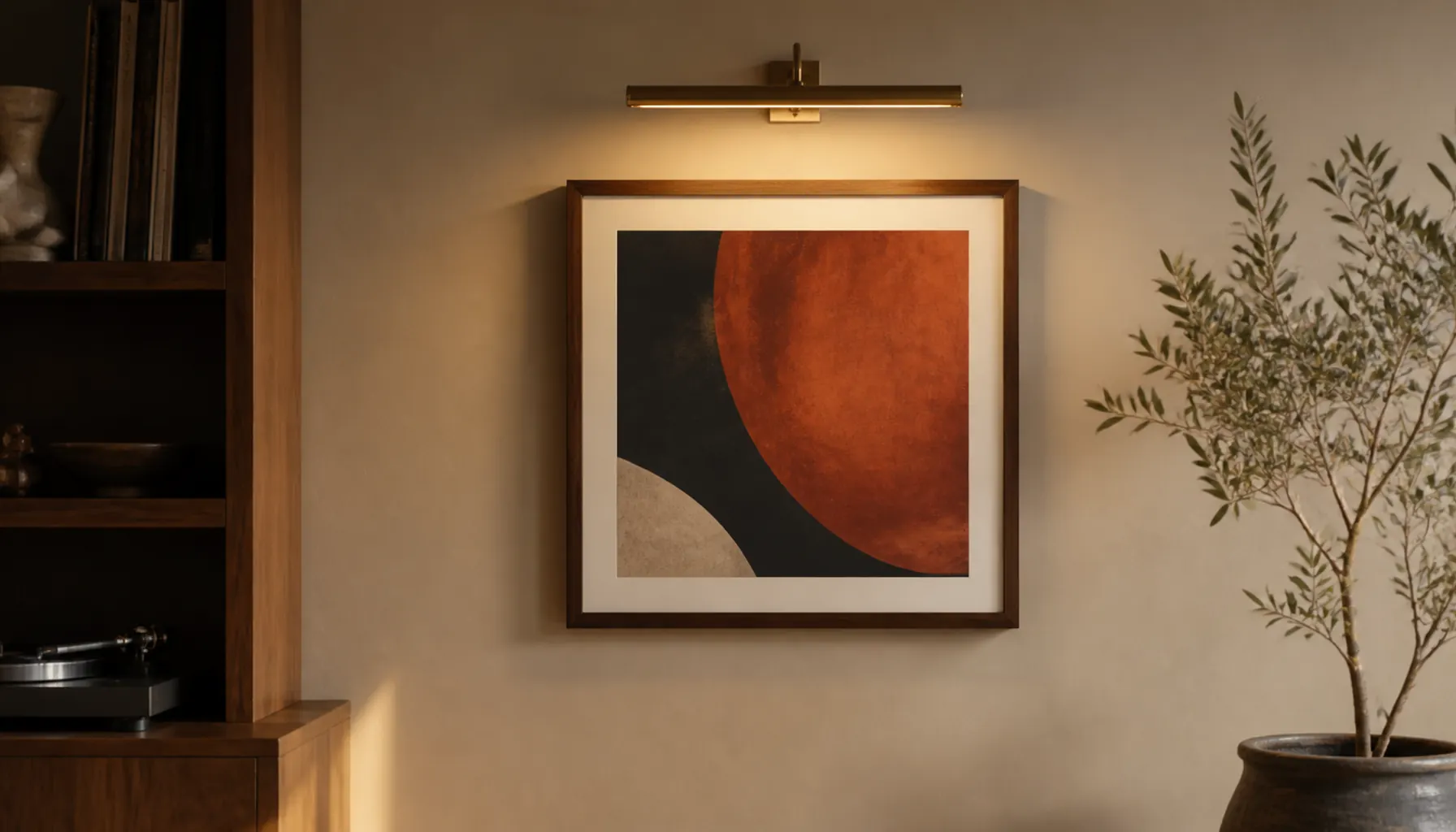
Album covers are printed on coated card, so a glossy sleeve behind glass reflects twice. The fix is angle. Light from above and close to the wall, so the beam hits the surface steeply and bounces down toward the floor instead of back at standing eye level.
A slim picture light above the frame or a couple of downward sconces do this well. What fails is a lamp sitting directly opposite the wall, or a ceiling fixture washing flat light across the glass. Matte acrylic glazing helps if the geometry is fixed. Check the wall after dark with your actual lamps on, since daylight hides the problem. Several of the lighting mistakes that make rooms feel cold show up on art walls first.
Idea 10: Build the Storage Below the Wall Around the Turntable
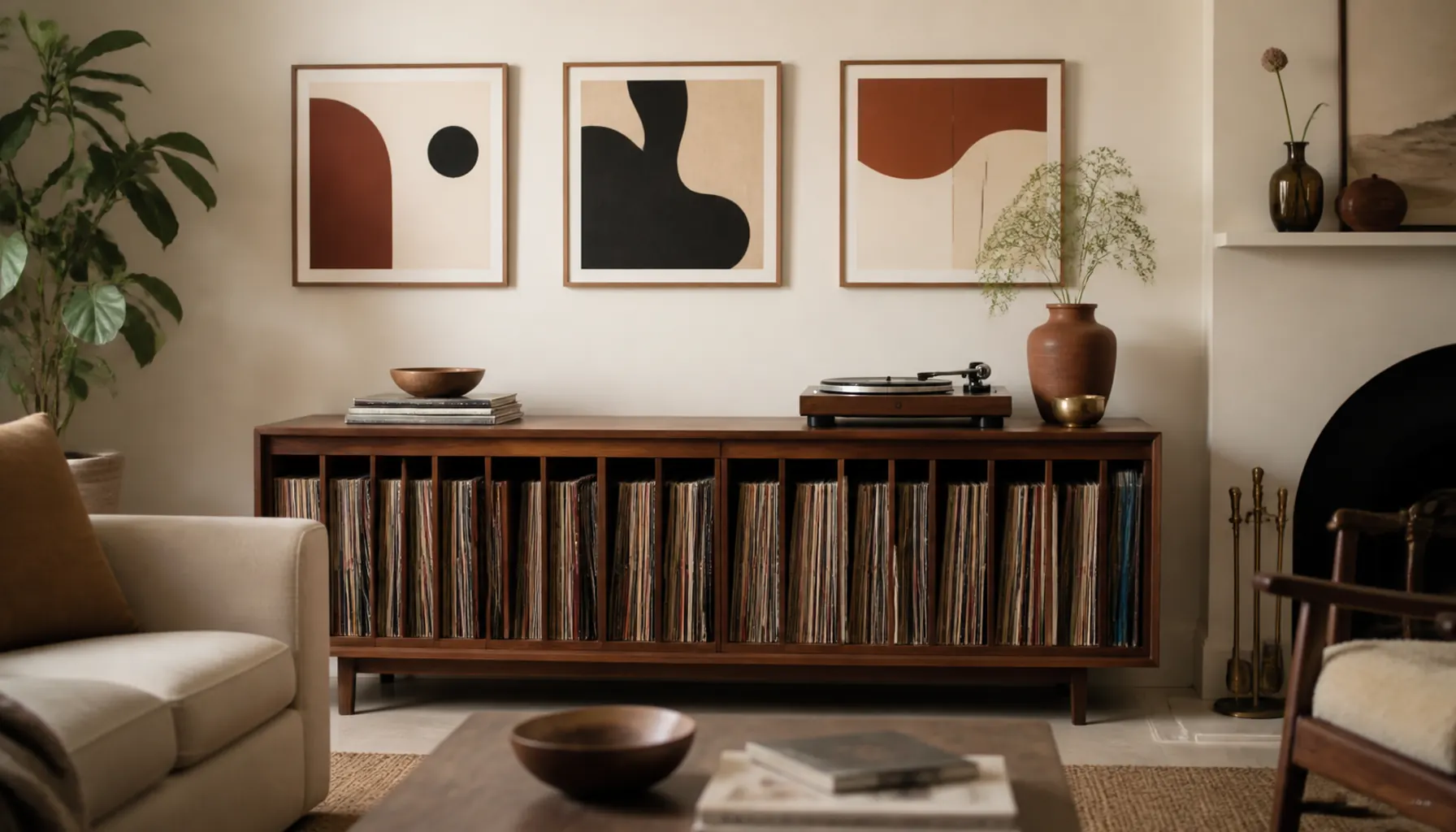
The wall only works if the furniture under it does. Set the console at a height where the platter sits at a comfortable working level, so cueing a record does not mean crouching. Records themselves need to stand upright, never stacked flat, with a divider every foot or so to stop a leaning row from bowing the sleeves.
Cube storage handles this cheaply, and a built-in handles it better if you are already planning cabinetry. Leave clearance between the top of the deck and the lowest frame for the lid to open. Route the cable behind the unit, since a loose lead across a styled surface undoes the whole thing. The proportions here follow the same logic as built-in cabinets in a living room.
Idea 11: Keep Display Copies Out of the Playing Crate
Say it plainly: a record you actually play should not be a record on your wall. Sunlight fades printed card quickly, and it also heats whatever is behind the glass, and heat is what warps vinyl.
So split them. Frame the sleeve and keep the disc in a poly inner in the crate, or use a thrifted duplicate, a scratched copy that is beyond playing, or a reissue you bought for the artwork. Nothing rare and nothing irreplaceable goes on the wall, and nothing at all goes on a wall that gets direct afternoon sun. If a favorite cover must be seen, the rotating ledge from earlier limits how long any one sleeve is exposed.
Idea 12: Stop Before the Room Becomes a Record Store
Restraint is the hardest idea here, and it decides whether the wall reads as taste or as inventory. One wall of music per room is plenty. Once sleeves appear on two walls, plus a guitar, plus a stack of frames on the ledge and a speaker grille in the corner, the room stops having a subject and starts having a theme.
Count the music references in the space and cut the weakest one. Then give the eye somewhere quiet to land: a broad stretch of sage or mushroom paint, a woven basket, a plant, a plain lamp. The same editing instinct that keeps open shelves from looking cluttered applies to a wall of covers. Fewer, better, with space around them.
Common Mistakes to Avoid
- Buying frames before measuring a sleeve. Standard print sizes do not fit album covers, and a bad fit shows on every frame in the group.
- Hanging the collection, not a selection. The wall is not storage. If a cover is up there only because you own it, take it down.
- Putting the whole thing in the sunniest spot in the room. It is usually the wall people want to fill, and it is the worst one for paper and vinyl.
- Spacing sleeves like posters. Twelve inch squares need tighter, more even gaps than mixed frames do, or the grid looks accidental.
- Forgetting the dust cover. A frame hung too low above a turntable gets knocked every time you play something.
Expert Tips for Pulling the Look Together
Repeat the frame finish, not the frame size. Four black frames at three different sizes hold together better than four matched frames in three different finishes, because the eye tracks color before it tracks proportion.
Let the wall color do some of the work. A warm sand or mushroom behind black frames gives more separation than bright white, which tends to make glossy sleeves look like they are floating. If you are choosing that color anyway, a whole house palette keeps the room connected to the ones around it.
Balance the hard, flat surfaces. A record wall is glass, coated card, and metal all at once, so put something soft underneath it: a wool throw on the arm of the sofa, a jute rug, a linen cushion. That contrast between smooth and coarse is the whole point of mixing textures, and it stops the corner reading as cold.
Black frames, blackened metal ledges, and a walnut console sit naturally in a warm industrial living room, which is often the easiest style home for a music wall.
Frequently Asked Questions
Will framing a record damage it?
Framing the sleeve is fine. Leaving the record inside the sleeve on the wall is the risk, because sunlight and warmth behind glass can warp vinyl and fade printed card. Keep the disc in a poly inner in your crate and frame the empty jacket, or use a duplicate copy you do not play. Never put an irreplaceable pressing on a wall.
Do I need special frames for album covers?
Not strictly, but they help. Album sleeves are slightly larger than 12 inches square, so frames made for standard photo sizes either pinch the edges or leave an uneven border. Frames sold for records fit properly, and front-loading versions let you change the sleeve without taking anything off the wall, which is worth the extra cost if you plan to rotate.
How many records should go on one wall?
Either six or more, or one. A cluster needs enough mass to read as intentional, and three squares on a wide wall usually looks stranded. On a narrow wall, a single large piece is the better answer. Beyond that, keep sleeves to under half the pieces in the group so the wall does not turn into a shop display.
Can I hang a guitar on drywall?
Use a hanger designed for the instrument and fix it into wall framing rather than into plasterboard alone. Also check the conditions before you commit: dry air, radiator heat, cold damp exterior walls, and direct sun all take a toll on wood and finishes. If the instrument is played regularly, keep it in its case and hang a cheaper one you do not mind exposing.
How do I stop glare on framed sleeves?
Light the wall from above at a steep angle so the reflection bounces toward the floor, using a picture light or downward sconces rather than a lamp facing the wall. Matte acrylic glazing helps when the light position cannot move. Test it after dark with your normal lamps on, because glare rarely shows in daylight photos.
Where to Start
Start with one framed sleeve above the turntable and a ledge beside it. That pairing gives you a fixed anchor and a changing element, costs very little, and tells you quickly whether you want a full wall or whether this small version was the right scale all along.
When you do expand, pull the frames off the wall of the room that gets the most afternoon light, mix in something that is not music, and leave a margin of bare paint around the group. The best music walls look like someone lives with the records, not like someone is selling them.
One useful home email a month
Real ideas to make your home work better. No spam, easy unsubscribe.